National Eligibility cum Entrance Test (NEET) is one of the vital exams in India for medical aspirants. Lakhs of examinees take this exam every year to fulfil their ambition of getting enrolled in the top MBBS and BDS colleges. Though preparations for the exam are vital, most of the students lose marks because of mistakes made while filling out and submitting the OMR sheet.
The OMR sheet of NEET 2026 is the official document on which your responses are calculated. A single mistake in bubbling, overwriting or personal information can result in rejection or loss of scores. So knowing the right way is very important.
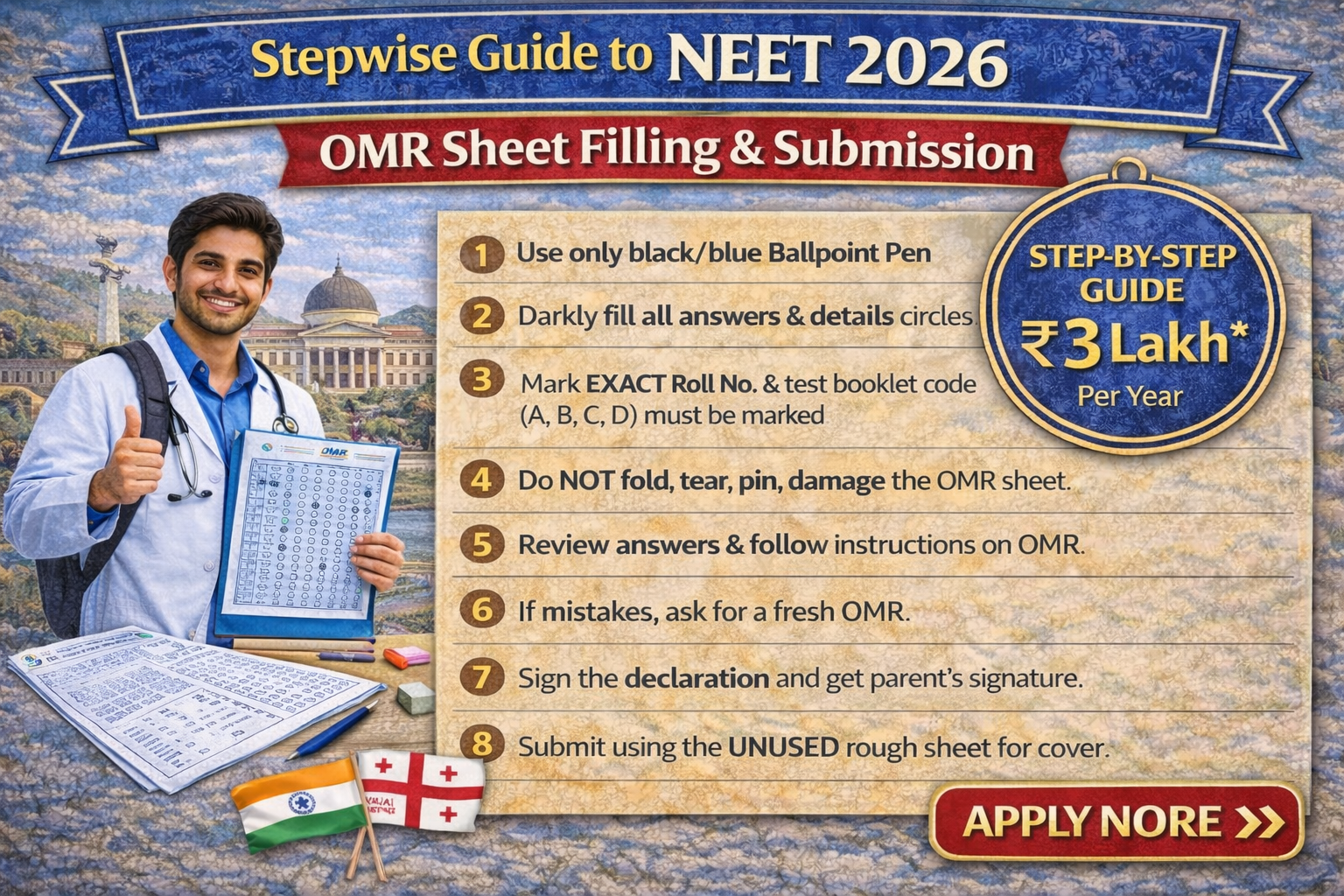
With the help of the NEET OMR sheet filling and submission procedure 2026, candidates will be able to fill and submit their NEET 2026 OMR Sheet without any difficulty.
Well, why is the OMR Sheet so important for NEET 2026?
Answers are checked electronically from the OMR (Optical Mark Recognition) sheet. The machine can only read properly marked bubbles. Any mistake, such as half-filled circles, improper markings or torn sheets, can lead to inaccurate scoring.
The culmination of your labour is all down to this ONE sheet! Thus, aspirants have to be very careful with it.
Step 1: Collection and Scrutiny of OMR Sheets
When the OMR sheet is handed over to you by the invigilator, do not start marking.
First, carefully check:
If the sheet is clean and in good condition
No folds, tears, or ink marks
All pages are properly printed
Roll number boxes are clear
In case of any defect, bring it immediately to the notice of an invigilator and obtain fresh material.
Never attempt any adjustment or repair to a defaced OMR sheet on your own.
Step 2: Fill in the Form Personal Details Carefully
You need to enter your name and basic information before you respond to a question.
Normally, the following information is requested:
Candidate Name
Roll Number
Application Number
Date of Birth
Exam Centre Code
Question Booklet Code
All work must be done in the black or blue ballpoint pen provided at the examination centre.
While filling in details:
Write neatly in capital letters
Do not overwrite
Do not use correction fluid
Bubble the corresponding numbers properly
This may happen due to an error in the roll number or booklet code.
Step 3: Know the Bubble Marking System
Each of the following questions has four choices (A), (B), (C) and (D). For each question, you need only darken one circle.
Correct way to mark:
Fill the bubble completely
Make it dark and clear
Do not leave white space
Do not tick or cross
Wrong marking methods include:
Half-filled bubbles
Light shading
Double marking
Using pencil
On the scanning, which only recognizes black bubbles completely covered.
Step 4: Answer Questions in an Organised Way
After filling out the particulars, start answering.
Recommended strategy:
First attempt, easy questions
Then move to the moderate ones
Keep difficult questions for later
Avoid random guessing
Do not rush. Maintain calm and focus.
Also Read: NEET 2019 Preparation Tips from Toppers: How to prepare for NEET? HISTORY AND also, both PHYSICS and CHEMISTRY first. Many toppers believe that solving Physics and Chemistry first, followed by Biology, is a good strategy.
Step 5: Cleanse the Overwrites and Corrections
Among the common mistakes students make, overwriting is one of the most serious.
Important rules:
Mark once, do not change the answer
No eraser is allowed
No whitener permitted
No crossing permitted
If you mess up, that question doesn’t count.
Therefore, think properly before bubbling.
Step 6: Cross-Verify the Answers with the Question Booklet Code
Each question in NEET has a booklet code (A, B, C, D, etc.) as well. One has to fill in the code correctly in the OMR sheet.
Your responses will be marked as incorrect with the incorrect paper.
All answers may become invalid.
The result can be seriously affected.
So, verify twice before filling.
Step 7: Ensure the cleanliness of the OMR Sheet
Your OMR sheet should not be tampered with at any time.
Avoid:
Folding the sheet
Spilling water
Smudging ink
Writing unnecessary notes
Making rough work
Rough work is to be done in the question paper itself and not on any OMR sheet.
Step 8: Read Again Before You Submit
Save 10–15 minutes for reviewing before submitting.
Check:
All details filled correctly
Roll number matched
No question left unanswered unintentionally
No double markings
Bubble alignment correct
This final check can save you from crippling loss.
Step 9: Document Submission at the Exam Centre
After completion:
Cease writing at the end of time
Pass the OMR sheet to the proctor
Do not rip or pull anything off
Do not take the OMR sheet outside
You can take the question paper only
Follow the invigilator's instructions strictly.
Post Exam: Predict Ranks
Students often estimate their final scores based on answer keys after the exam.
Applicants can use a trustworthy NEET rank predictor to know their chances for admission.
A reliable NEET rank predictor assists in:
Estimating probable All India Rank
Checking category-wise position
Analyzing cutoff trends
Planning counselling choices
Shortlisting colleges
This provides clarity ahead of official results.
Importance of Recognised Medical Institutions
Candidates preparing to get admitted should ensure that their chosen colleges are approved and recognised.
In India, medical education is governed by the National Medical Commission (NMC). MBBS admission is only for NMC-approved colleges.
Internationally, standards of practice are influenced by the WHO.
For those who are planning to pursue an MBBS abroad, it is advisable that you check the institution with WDOMS – World Directory of Medical Schools for worldwide acceptance.
Pick reputable schools to keep your future-proof.
Most Common OMR Filling Mistakes to Avoid
Here are some common mistakes students make:
Using a pencil instead of a pen
Leaving personal details blank
Wrong booklet code
Double bubbling
Overconfidence and rushing
Not reviewing before submission
By avoiding these, your life will be more likely to succeed.
Psychological Tips During OMR Filling
Mental stability is equally important.
Follow these tips:
Take deep breaths
Stay calm
Ignore others
Focus on your sheet
Do not be frazzled by challenging questions
A mind that is at peace makes fewer mistakes.
Conclusion
The process of filling and submitting the NEET 2026 OMR sheet is as significant as preparing for the examination. A single careless error can wipe out years of hard work.
In this step-by-step resource, learners can be confident that they:
Accurate personal details
Proper answer marking
Error-free submission
Better evaluation outcome
Post exam, candidates can make use of tools like the NEET rank predictor for realistic rank estimation and counselling.
Besides the academics, administrative knowledge and control of examination proceedings are essential for a hassle-free ride from the examination hall to the medical college.