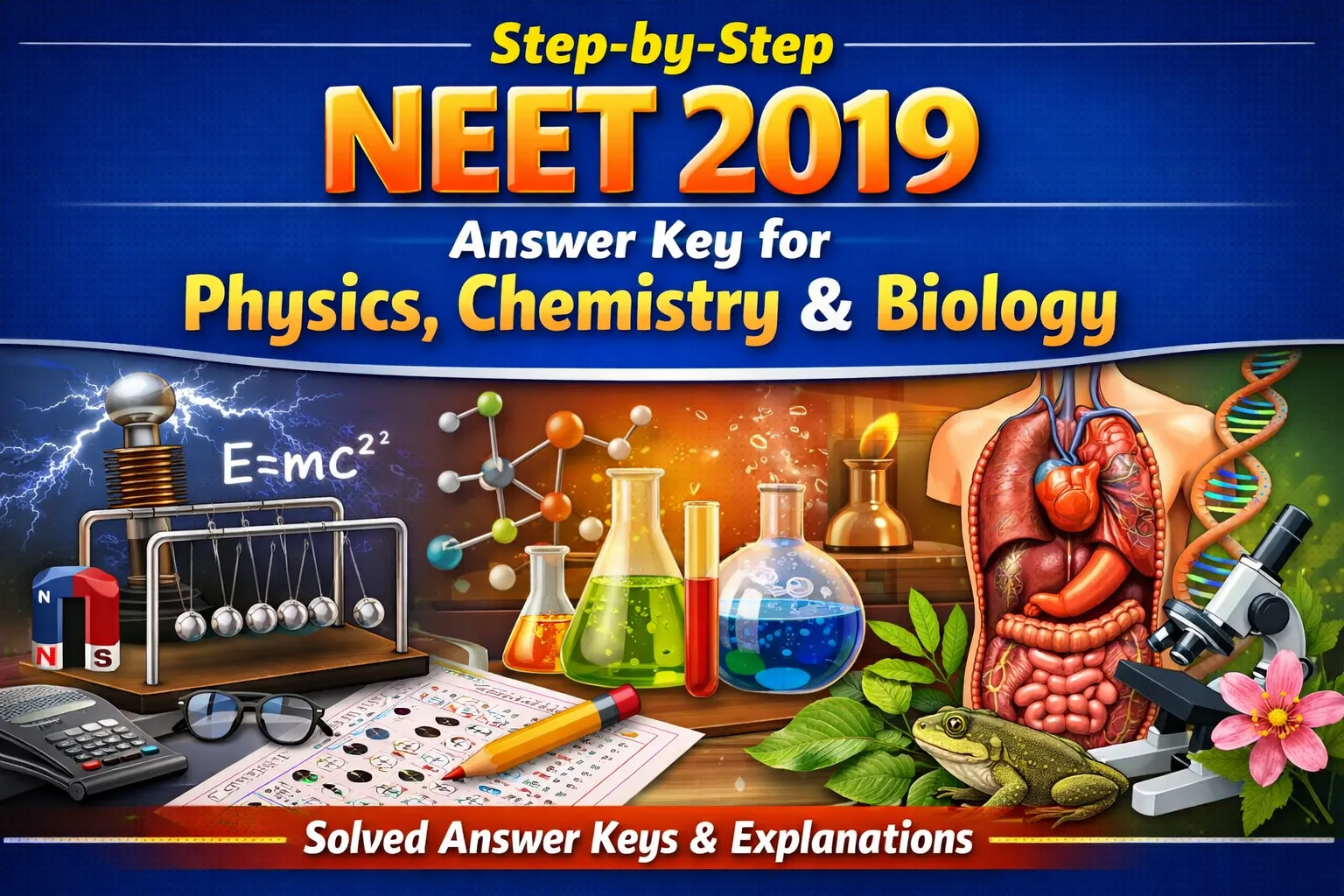
NEET 2019 Answer Key for Physics, Chemistry & Biology – Complete Guide
The NEET 2019 examination was a major milestone for medical aspirants across India. Lakhs of students appeared for the exam with the goal of securing admission into top medical colleges.
After the exam, the NEET 2019 answer key becomes an essential resource for students to evaluate their performance and estimate their expected score. By comparing their responses with the official solutions for Physics, Chemistry, and Biology, candidates can calculate their approximate marks.
Using the estimated score, students often predict their expected rank with the help of the NEET Rank Predictor, which helps them understand their admission chances. Properly analysing the answer key can also help future aspirants preparing for NEET 2026 improve their preparation strategies.
What is the NEET Answer Key?
The NEET answer key is an official document released after the exam that contains the correct answers to all questions asked in the paper.
Students use it to calculate their expected score before the final result is announced.
NEET Marking Scheme
The evaluation system used in NEET is simple:
+4 marks for every correct answer
–1 mark for every incorrect answer
0 marks for unanswered questions
By applying this marking scheme to their responses, candidates can estimate their total marks and then use the NEET Rank Predictor to estimate their probable rank.
NEET 2019 Subject-wise Question Distribution
The NEET UG exam consists of three main subjects.
| Subject | Questions |
|---|---|
| Physics | 45 |
| Chemistry | 45 |
| Biology | 90 |
Total Questions: 180
Maximum Marks: 720
Biology generally carries the highest weightage, while Physics is often considered the most challenging section.
Medical entrance standards in India are regulated by the National Medical Commission which maintains quality in medical education and examinations.
How to Calculate NEET 2019 Score – Step-by-Step Guide
Students can calculate their expected score using the answer key by following these steps.
Step 1: Download the Answer Key
Students must download the official NEET 2019 answer key released by the exam authority and ensure the question paper code matches their paper.
Step 2: Match Your Responses
Compare every question in the paper with the answer given in the answer key.
Mark responses as:
Correct
Incorrect
Unanswered
Step 3: Apply the Marking Scheme
Use the NEET marking system.
Example:
Correct answers: 140 × 4 = 560
Incorrect answers: 10 × –1 = –10
Estimated score = 550 marks
Step 4: Predict Your Rank
Once the estimated score is calculated, students can use the NEET Rank Predictor to check their expected rank based on previous years' trends.
This helps students understand their chances of getting admission into government medical colleges.
Physics Answer Key Analysis
Physics is often considered the toughest section in NEET.
The NEET 2019 Physics section included many numerical questions requiring strong conceptual clarity.
Important topics included:
Mechanics
Modern Physics
Electrostatics
Current Electricity
Thermodynamics
While analysing the Physics answer key, students should identify mistakes such as:
Calculation errors
Misreading the question
Weak conceptual understanding
Chemistry Answer Key Analysis
Chemistry questions in NEET are divided into three major parts:
Physical Chemistry
Organic Chemistry
Inorganic Chemistry
Many questions in NEET 2019 were directly based on NCERT concepts.
Steps to analyse Chemistry answers:
Identify correctly solved questions
Check guessed answers
Review incorrect responses
Chemistry performance improves with strong conceptual understanding and practice.
Biology Answer Key Analysis
Biology carries the highest weightage in NEET with 90 questions (360 marks).
Most Biology questions in NEET 2019 were directly based on NCERT textbooks.
Major topics included:
Human Physiology
Genetics
Ecology
Plant Physiology
Biotechnology
When reviewing the Biology answer key:
Compare every option carefully
Revisit NCERT explanations for wrong answers
Highlight important concepts in textbooks
A strong Biology score significantly improves the final rank.
Importance of Reviewing the Answer Key
Analysing the NEET 2019 answer key is helpful not only for that year's candidates but also for aspirants preparing for NEET 2026.
Benefits include:
Understanding the exam pattern
Identifying frequently asked topics
Improving time management
Learning from mistakes
Students can gain valuable insights from previous year papers and answer key analysis.
Using a NEET Rank Predictor
After calculating the estimated score using the answer key, students often want to know their expected rank.
A NEET Rank Predictor estimates rank based on:
Exam score
Previous year cutoff trends
Total number of candidates
Although the predicted rank is approximate, it helps students understand admission possibilities.
Medical Education Recognition and Global Standards
Students planning to study medicine must also understand medical regulatory bodies.
The National Medical Commission regulates medical education in India and determines whether foreign medical degrees are valid for licensing.
Global health organizations such as the World Health Organization help maintain international medical education standards.
Another important database is the World Directory of Medical Schools which lists recognized medical schools worldwide.
Students considering studying abroad should ensure their university is listed in WDOMS.
NEET 2019 Analysis for NEET 2026 Aspirants
The NEET 2019 paper offers useful insights for future aspirants.
Key observations include:
Strong emphasis on NCERT textbooks
Conceptual questions in Physics
Application-based Chemistry problems
Direct Biology questions from NCERT
Regularly solving previous year papers helps students understand the difficulty level and improve their speed.
Using tools like the NEET Rank Predictor along with performance analysis helps students set realistic preparation goals.
Conclusion
The NEET 2019 answer key is an important resource for analysing exam performance and estimating scores. By carefully checking responses and applying the marking scheme, students can calculate their expected marks and then estimate their rank using the NEET Rank Predictor.
Answer key analysis for Physics, Chemistry, and Biology also helps identify weak areas and improve preparation strategies.
Understanding the role of organizations like the National Medical Commission, World Health Organization, and World Directory of Medical Schools is also important for students considering medical education options.
Ultimately, success in NEET depends on consistent practice, analysing previous year papers, and strategic preparation. 🚀