NEET 2019 Question Paper with Answer Key and Solutions: PDF
National Eligibility cum Entrance Test (NEET) is the most crucial entrance exam for students seeking admission to MBBS along with other medical programmes across India. This makes it one of the most competitive examinations in the country with millions of aspirants appearing for this exam every year.
Solving previous year question papers is one of the best ways to prepare for NEET. The NEET 2019 question paper is specifically suggested among them since it gives the idea of the exam problem, which topic gets repeated every year and the entire pattern of examination.
Based on the marks obtained, the students who solve previous year papers can estimate their expected score and rank using tools like NEET Rank Predictor to understand how to strategize for medical admission.
Some students seek admission outside India, where those attending universities that are listed in the World Directory of Medical Schools and recognized by organizations such as the World Health Organization and approved by the National Medical Commission will receive internationally accepted medical degrees. Many students explore opportunities such as mbbs in georgia for global medical education.
NEET 2019 Exam Pattern
Exam pattern is the build up of paper, so with help of this students can solve their papers more efficiently.
Subject | Questions | Marks
Physics | 45 | 180
Chemistry | 45 | 180
Biology (Botany + Zoology) | 90 | 360
Total | 180 | 720
Key rules:
+4 for every correct answer
−1 for every wrong answer
3 hours exam duration
Due to the negative marking, while solving the question paper, accuracy becomes very important.
Benefits of Solving NEET 2019 Question Paper
Understand the Exam Difficulty
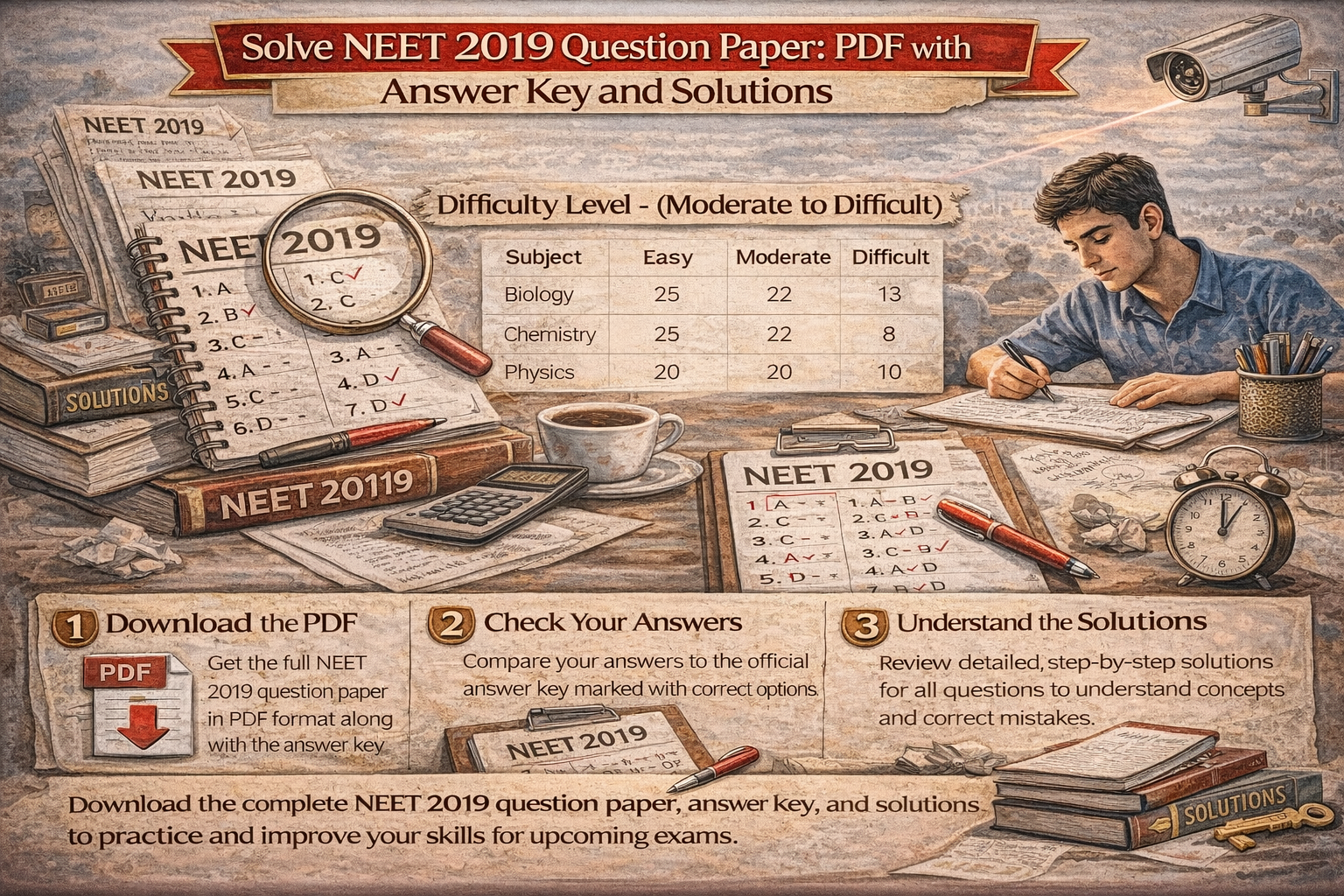
Overall, the NEET 2019 exam was moderate, but Physics was slightly difficult as compared to Chemistry and Biology.
Identify Important Topics
We can track the topics which have been asked in previous year papers and we should target these in preparation as well.
Improve Time Management
Doing the full paper under exam conditions (3 hrs) helps students improve time management.
Estimate Rank
Candidates can assess their estimated score and use the NEET Rank Predictor after completing the paper.
NEET 2019 Question Paper Subject-wise Analysis
Physics
The most difficult section was considered to be physics.
Important topics included:
Mechanics
Current electricity
Electrostatics
Modern physics
Optics
Numerical and conceptual based questions dominated the section.
Chemistry
Chemistry was relatively easier and primarily based on NCERT.
Important topics included:
Chemical bonding
Coordination compounds
Thermodynamics
Organic reactions
Periodic table
Students who studied NCERT thoroughly performed well in this section.
Biology
The highest weightage in NEET was of Biology, which had 90 questions.
Key topics included:
Human physiology
Genetics and evolution
Ecology and environment
Plant physiology
Cell biology
Most questions were straightforward and NCERT-based.
Example Questions from NEET 2019
To give you an idea of some of the questions asked, here are a few sample questions similar to what was seen in the NEET 2019 paper.
Physics Example
Example: Motion of a particle under uniform acceleration. If the initial velocity is zero and acceleration is constant, the displacement is:
s = ut + ½ at²
Answer:
s = ½ at²
Chemistry Example
Which of the following elements is the most electronegative?
A. Nitrogen
B. Fluorine
C. Oxygen
D. Chlorine
Correct Answer: Fluorine
Biology Example
The part of the human brain that regulates body temperature.
A. Cerebrum
B. Hypothalamus
C. Medulla
D. Cerebellum
Correct Answer: Hypothalamus
NEET 2019 Question Paper: How to Utilize it for Practice
Students should follow a proper strategy to solve the papers.
Step 1: Solve the Paper Under Exam Conditions
Spend 3 hours non-stop attempting all questions.
Step 2: Check the Answer Key
Now check your answers against the official answer key and find your score.
Step 3: Analyze Mistakes
Revise concepts, especially if it was a question you got wrong.
Step 4: Predict Rank
Use tools such as the NEET Rank Predictor to get a rough estimate of expected rank based on score.
Why Should We Practice Previous Year Papers
There are numerous benefits of solving past year papers.
Better Understanding of Question Patterns
Students get accustomed to how questions are presented in the exam.
Improved Accuracy
Repeated practice reduces careless mistakes.
Stronger Conceptual Knowledge
Concepts are reinforced by solving different types of questions.
What to Do if You Are Unable to Secure a Medical Seat in India
As NEET is one of the most hotly contested exams in India, even candidates who qualify for the exam are unable to secure MBBS seats.
This is the main reason many students search for international medical education options like mbbs in georgia.
Medical universities offering mbbs in georgia usually provide:
Affordable tuition fees
English-medium medical programs
Globally recognized medical degrees
These universities are recognized by the World Health Organization, listed in the World Directory of Medical Schools and approved by the National Medical Commission, allowing graduates to appear for licensing exams after completing their degree.
NEET Question Papers: How to Solve Them?
Here are some tips that will help improve performance while practicing NEET papers:
Start with Biology since it has maximum weightage
Solve Chemistry next as it is generally scoring
Attempt Physics last because it takes more time
Avoid guessing answers because of negative marking
Practice full-length mock tests regularly
Conclusion
Solving the NEET 2019 question paper with solutions can be a great strategy for students preparing for upcoming NEET exams. It helps candidates understand the exam pattern, important topics and time management strategies.
Analyzing previous year papers also allows students to estimate their expected rank using tools like the NEET Rank Predictor and plan their admission strategy accordingly.
However, due to intense competition for medical seats in India, some students also explore alternatives such as mbbs in georgia where universities are recognized by global organizations like the World Health Organization, the World Directory of Medical Schools and the National Medical Commission.
Ultimately, consistent practice, strong conceptual clarity and an effective exam strategy remain the key factors for success in NEET.