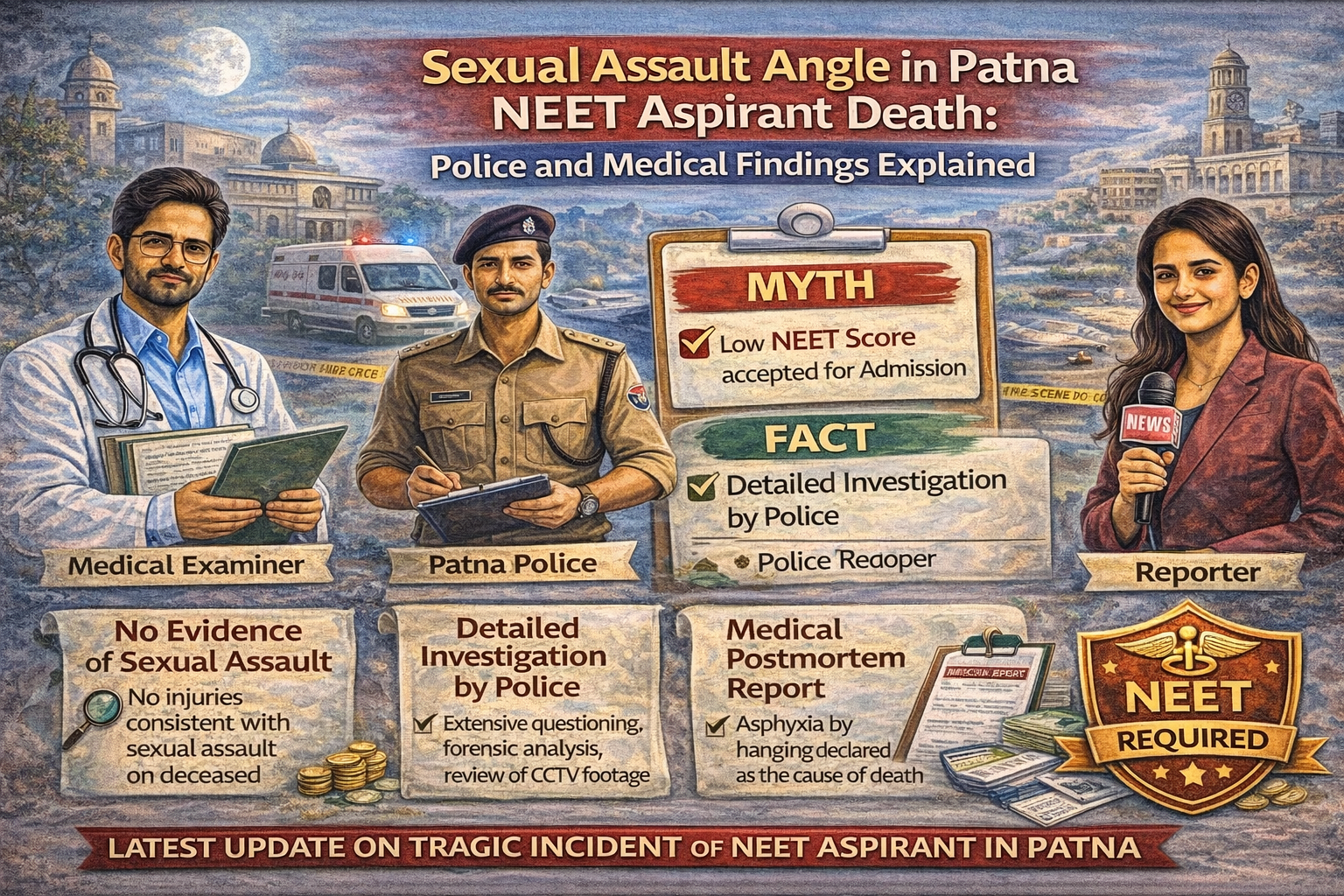
The case of the death of a NEET aspirant in Patna has taken an ugly turn, with medical investigations revealing that the sexual assault angle cannot be ruled out. A case that initially was framed in terms of a medical emergency or personal distress has grown into a delicate criminal investigation, focusing the nation’s attention on student safety and investigative openness.
The student was studying for NEET UG, or National Eligibility and Entrance Test (Under Graduate), which is India’s national entrance examination for admission to undergraduate medical schools. It is not just the academic community that has been shaken by this incident, but also uncomfortable questions on hostel security, medical response, and the early approach to the case.
How the Sexual Assault Angle Came Out
At the time, officials said the student’s condition could have been related to health issues or medication. But family members’ concerns and discrepancies in early explanations prompted the thorough forensic review.
The post-mortem discoveries turned the investigation on its head, indicating that sexual assault could not be dismissed as a possible motive. The medical observation sparked law enforcement officials to broaden the focus of the investigation beyond accidental injury or self-injury.
What Medical Findings Indicate
Several of the conclusions reached by medical experts involved in the post-mortem raised red flags:
Ante-mortem Many Wounds: Wounds could be seen on many parts of the body, suggesting trauma that had occurred prior to death.
Physical Resistance: Bruising and scratches indicated that the victim had perhaps resisted before losing consciousness.
Non-Consistent Physical Indicators of Sexual Assault: The sexual assault allegations were not proven, but there was a note that verification of any further required forensic pathology.
These results were against the previous hypothesis and further warranted more in-depth analysis.
Police Stand and Investigation Status
The police then accepted, in view of medical opinion, that the forensic fact observations were grave and added that every angle was being probed here. A dedicated team of investigators was put in place to provide a narrow focus.
Areas being looked into by the police are:
Hostel premises and access control
CCTV footage from surrounding areas
Statements from the hostel staff and others nearby
Medical response timeline and documentation
Politicians have said no judgment will be made until all forensic, medical, and circumstantial evidence is laid out.
The Role of the Medical Records and Inconsistencies
#Questions #MumbaiActually Is it true that hospital and post-mortem reports are fudged Forensic evidence later pointed to possible violence, according to early medical notes that did not apparently mention signs of assault.
These inconsistencies have led to questions regarding:
Promptness and correctness of the medical examination
Documentation protocols in emergency cases
Whether critical observations were overlooked
These questions have added to calls from the public for more transparency.
How the Case Raises Broader Safety Issues
The incident has also once again raised the issue of the safety of students, particularly young women, staying in private hostels as they get ready for high-stakes exams like NEET UG.
Medical education in India is regulated by the National Medical Commission (NMC) and focuses on ethics, professionalism, and student welfare. Firstly, though the NMC rules feel cramping to medical colleges, as now your urge to do anything can be curbed by an official knock, safety for aspiring doctors still does not have a uniform ecosystem.
Student Well-Being and Public Health Viewpoint
More generally, student safety and mental health are public health problems of great concern. The World Health Organization (WHO) identifies safe places to live and freedom from violence as fundamental influences on health.
The Patna case exemplifies how failures in safety can result in tragic consequences, particularly for students under academic and emotional stress.
Academic Pressure and Aspirant Vulnerability
NEET students have the agony of cut-throat competition, a limited number of seats, and long hours of isolation. They depend upon such analysis like neet rank predictor to help them determine their streak and what they should expect.
But experts are quick to point out that academic tools can never overcome unsafe living conditions, lack of adult supervision, or the failure to call for help in response to emergencies.
Impact on the Medical Education Ecosystem
Healthcare providers must maintain ethical professionalism at all times. Institutions with a responsibility for medical education, such as those already accredited by the World Directory of Medical Schools (WDOMS) are expected to demonstrate a commitment to the principles of safety, dignity, and well-being throughout the student pathway globally.
If medical school aspirants themselves encounter a hostile environment even before getting into medical colleges, it’s a serious thing to wonder about the ecosystem nurturing future healthcare providers.
Public Reaction and Calls for Accountability
Potential sexual violence in the case has generated outcry, protests and demands for swift justice. Students, parents, civil society, and education groups are calling for:
Transparent disclosure of investigation findings
Accountability for negligence, if any
Stricter regulations regarding the safety of student housing
The story became a symbol of the dangers that aspiring medical students face.
Conclusion
The angle of sexual assault in the Patna NEET aspirant's death has turned the tragic loss into an urgent public concern. Medical evidence suggesting potential violence gives urgency to the call for a full and fair investigation.
“While investigations are on to find out what led to the tragedy, their entire focus must be now directed toward delivering justice for the victim and bringing about meaningful reforms in order to make students getting ready for NEET UG examinations feel safe, protected, and supported.” Securing candidates is not only a legal responsibility; it is also a moral one.