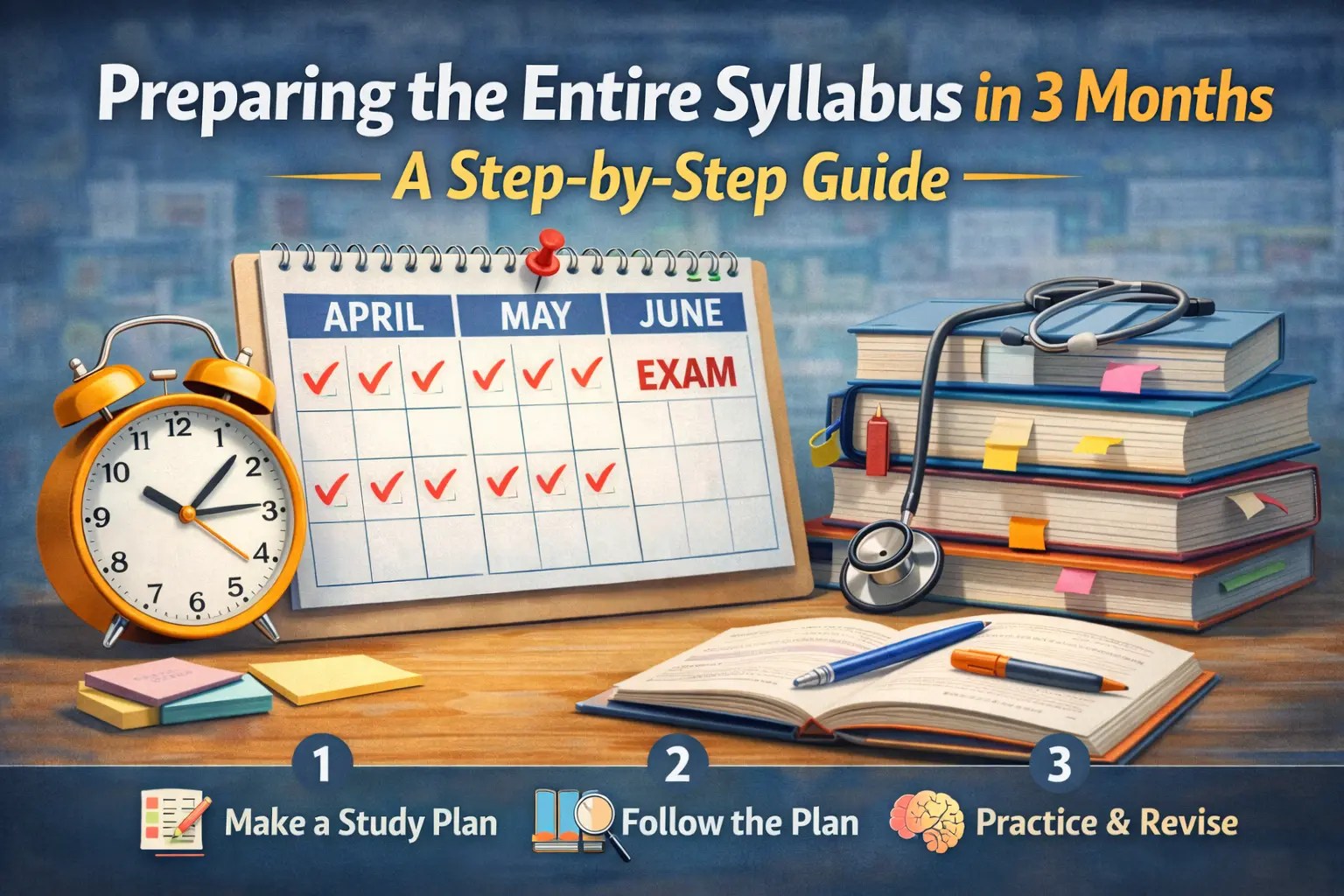
Preparing the Entire Syllabus in 3 Months — A Step-by-Step Guide
Preparing for a competitive medical entrance exam in a short period can feel overwhelming. Many aspirants believe that covering the entire syllabus within three months is impossible. However, with the right strategy, disciplined study habits, and a structured plan, it is possible to revise the entire syllabus effectively within this timeframe.
Medical entrance exams like NEET PG test the knowledge gained during the MBBS program across multiple subjects. Candidates must balance conceptual understanding, revision, and practice through mock tests. Many aspirants also use tools such as a NEET Rank Predictor to evaluate their performance after mock tests and estimate their potential rank.
In this guide, we will explain how to prepare the entire syllabus in three months with a step-by-step strategy, while also highlighting the importance of organizations such as NMC, WHO, and WDOMS in maintaining medical education standards.
Understanding the 3-Month Preparation Strategy
Three months may seem like a short time to cover the entire syllabus, but it can be enough if preparation is planned carefully.
A successful three-month preparation plan should focus on:
Prioritizing high-yield topics
Completing multiple revision cycles
Practicing mock tests regularly
Maintaining consistency and discipline
Instead of trying to learn everything from scratch, candidates should focus on revision and conceptual clarity.
Month 1: Build a Strong Foundation
The first month should focus on completing the entire syllabus once while strengthening basic concepts.
Step 1: Create a Study Plan
Divide the syllabus into manageable sections and assign specific subjects to each day.
A realistic plan may include:
10–12 hours of study daily
Completing 2–3 subjects every week
Setting daily learning targets
Breaking the syllabus into smaller sections helps maintain focus and avoid burnout.
Step 2: Focus on High-Yield Topics
Not all topics carry the same weightage in the exam. Aspirants should prioritize high-yield areas that are frequently tested.
These include:
Pathology
Pharmacology
Medicine
Surgery
Microbiology
Studying high-yield topics first increases the chances of scoring well in the exam.
Step 3: Make Short Notes
Short notes are extremely useful during revision.
They should include:
Important concepts
Key facts
Diagrams and flowcharts
Clinical correlations
These notes will become valuable during the final revision phase.
Month 2: Strengthen Concepts and Start Practice
The second month should focus on deep revision and question practice.
Step 4: Attempt Daily MCQs
Solving multiple-choice questions helps candidates understand how concepts are tested in the exam.
Benefits of daily MCQ practice include:
Improving problem-solving skills
Identifying weak areas
Increasing accuracy and speed
After attempting MCQs, candidates should carefully analyze incorrect answers.
Step 5: Start Mock Tests
Mock tests simulate the real exam environment.
Aspirants should attempt at least one full-length mock test every week during the second month.
Many candidates analyze their scores using a NEET Rank Predictor to estimate their expected rank and measure progress.
This helps them understand whether their preparation is on track.
Step 6: Focus on Weak Subjects
Mock test analysis helps identify weak areas.
During the second month, aspirants should dedicate extra time to improving subjects where they score lower.
This targeted approach significantly improves overall performance.
Month 3: Intensive Revision and Performance Optimization
The final month should focus on rapid revision and exam-level practice.
Step 7: Multiple Revision Cycles
Aspirants should aim to revise the entire syllabus at least two to three times during the final month.
Effective revision strategies include:
Reviewing short notes
Solving previous years’ question papers
Revisiting high-yield topics
Frequent revision improves memory retention and exam confidence.
Step 8: Increase Mock Test Frequency
During the final month, candidates should attempt two to three mock tests per week.
After each test, it is important to analyze:
Incorrect answers
Time management issues
Conceptual mistakes
Many students again evaluate their scores with a NEET Rank Predictor to estimate their potential rank before the actual exam.
Daily Study Routine for a 3-Month Plan
A structured daily routine helps maintain consistency.
An effective study schedule may look like this:
Morning (6–9 AM)
Revision of previously studied topics.
Late Morning (10 AM – 1 PM)
Study a new subject or chapter.
Afternoon (2–5 PM)
Solve MCQs related to the studied topic.
Evening (6–9 PM)
Review mistakes and revise important concepts.
Night (10–11 PM)
Quick revision or short notes review.
Consistency in following a daily routine is essential for completing the syllabus in three months.
Importance of Mock Tests and Rank Prediction
Mock tests play a crucial role in exam preparation.
They help aspirants:
Understand the exam pattern
Improve speed and accuracy
Develop time management skills
Many aspirants use a NEET Rank Predictor after mock tests to estimate their expected rank based on their score.
This allows candidates to track improvement and adjust their preparation strategy.
Role of NMC in Medical Education
The NMC regulates medical education and professional standards in India.
The NMC is responsible for:
Approving medical colleges
Monitoring medical training quality
Regulating postgraduate medical education
Ensuring standardized medical curriculum
The exam structure and syllabus of medical entrance examinations are aligned with the curriculum guidelines established by the NMC.
Importance of WHO in Healthcare Education
The WHO plays an important role in global healthcare policy and medical research.
WHO supports:
Global health initiatives
Disease prevention strategies
Medical research collaboration
Healthcare training standards
Concepts related to public health and epidemiology often draw from research supported by WHO.
Role of WDOMS in Global Medical Recognition
The WDOMS is a global database that lists recognized medical institutions.
Medical colleges included in WDOMS gain international recognition, allowing graduates to pursue medical careers abroad.
This recognition helps graduates apply for licensing examinations such as:
USMLE
PLAB
AMC
Being listed in WDOMS ensures that medical institutions meet global educational standards.
Common Mistakes to Avoid During a 3-Month Preparation
Aspirants preparing in a limited time should avoid certain mistakes.
These include:
Studying new topics without revising old ones
Ignoring mock tests
Spending too much time on low-yield topics
Skipping short notes and revision strategies
Avoiding these mistakes helps maintain an efficient preparation process.
Tips to Stay Motivated
Maintaining motivation during intense preparation can be challenging.
Helpful strategies include:
Setting realistic daily goals
Taking short breaks to avoid burnout
Tracking progress through mock tests
Maintaining a healthy routine
Monitoring progress through tools like a NEET Rank Predictor can also motivate aspirants by showing gradual improvement in expected rank.
Conclusion
Preparing the entire medical exam syllabus in three months may seem challenging, but it is achievable with a disciplined approach and a well-structured plan. Candidates should focus on completing the syllabus quickly, revising high-yield topics, practicing MCQs, and attempting regular mock tests.
Tracking performance using tools such as a NEET Rank Predictor can help aspirants estimate their expected rank and adjust their preparation strategy accordingly.
Meanwhile, regulatory bodies like the NMC ensure high standards of medical education in India, while international organizations such as WHO and WDOMS contribute to maintaining global healthcare education standards.
With consistent effort, effective revision, and smart preparation strategies, aspirants can successfully cover the entire syllabus within three months and improve their chances of achieving a competitive rank.