Preparation Timeline of NEET 2019 Toppers: Detailed Plan
NEET: The National Eligibility cum Entrance Test (NEET) is one of the most important entrance exams in India for students wishing to pursue a career as a doctor. Every year, millions of students compete for a limited number of medical seats. If you are preparing for competitive exams like NEET 2026, the preparation strategies followed by toppers can provide valuable guidance.
Aspirants must have a strong study plan in place, and studying the preparation timeline of successful candidates can significantly improve their chances of success. Most toppers followed a disciplined and step-by-step approach that included concept building, practice, revision, and mock testing.
After the examination, students often check their expected rank using the NEET Rank Predictor to estimate their position and plan their counselling strategy. Some aspirants also explore international medical education options such as mbbs in georgia, where universities are recognized by the National Medical Commission and listed in the World Directory of Medical Schools with approval from the World Health Organization.
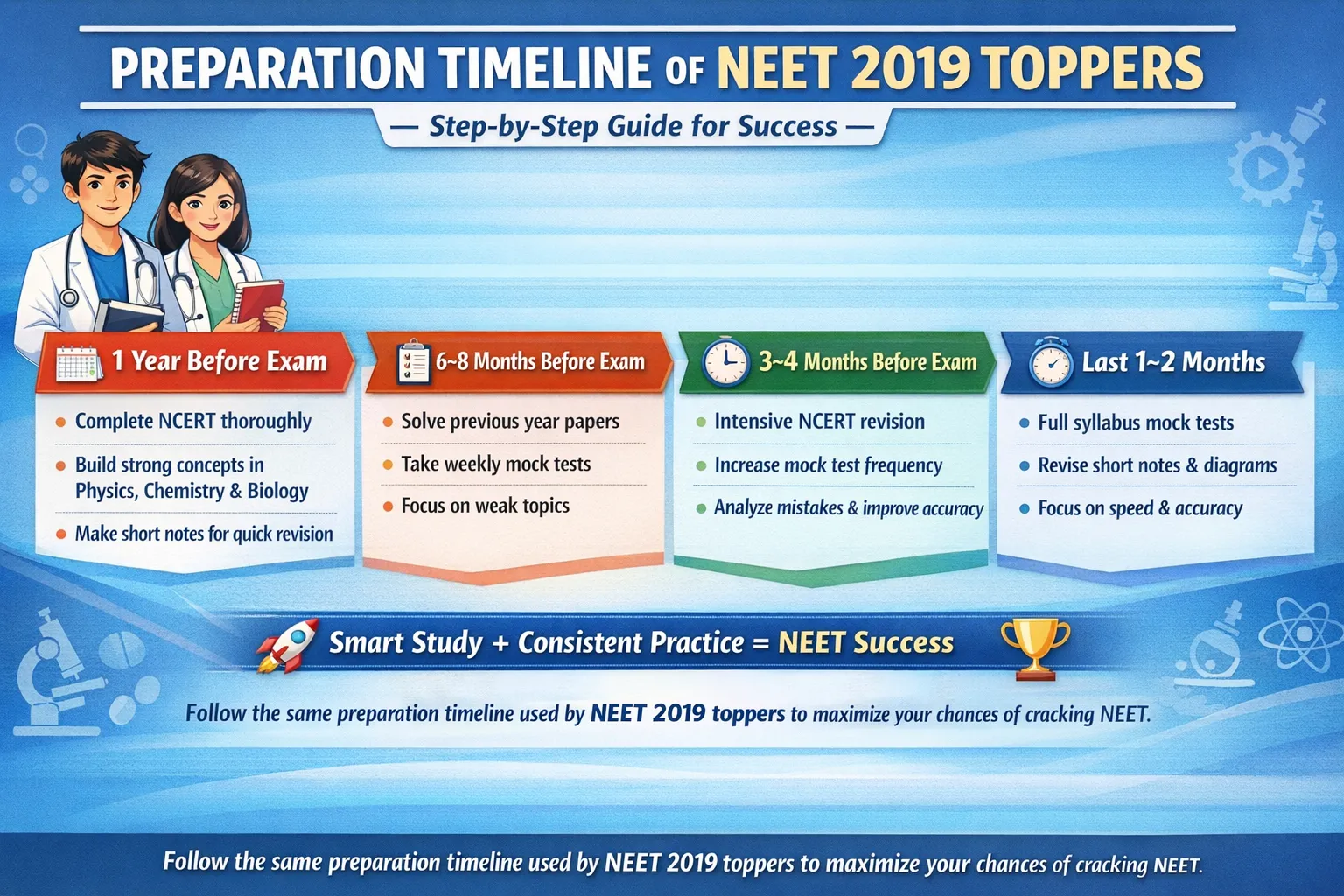
To help you plan your preparation effectively, here is a step-by-step timeline inspired by NEET 2019 toppers.
Phase 1: Foundation Building (12–18 Months Before Exam)
The first phase of preparation focuses on building strong basics across all subjects.
Most NEET 2019 toppers began their preparation during Class 11. This stage is crucial for understanding the core concepts of Physics, Chemistry, and Biology.
Key Activities in This Phase
Study NCERT textbooks thoroughly
Focus on conceptual clarity
Make detailed notes for revision
Solve basic practice questions
Important Subjects to Focus On
Mechanics in Physics
Organic Chemistry basics
Cell Biology and Human Physiology
Building a strong foundation at the beginning makes it easier to handle complex topics later.
Phase 2: Concept Refinement (9–12 Months Before Exam)
After completing the basic syllabus, toppers concentrated on refining their conceptual understanding.
Students revise important topics and begin solving more advanced questions during this phase.
Key Activities
Solve chapter-wise question banks
Practice numerical problems in Physics
Revisit diagrams and concepts in Biology
Begin solving previous year NEET questions
This stage helps students identify weak areas and improve their accuracy.
Phase 3: Intensive Practice (6–9 Months Before Exam)
During this stage, NEET toppers significantly increased their problem-solving practice and began taking mock tests regularly.
Practice is extremely important for competitive exams because it improves both speed and accuracy.
Key Activities
Take weekly mock tests
Analyze mistakes carefully
Improve time management
Strengthen weak subjects
Students also start connecting concepts across multiple subjects in this phase.
Phase 4: Revision and Exam Simulation (3–6 Months Before Exam)
At this stage, the majority of the syllabus has already been completed. The main focus shifts to revision and exam simulation.
Many NEET 2019 toppers emphasized that consistent revision is the key to success.
Key Activities
Revise NCERT multiple times
Solve full-length mock tests
Review formulas and chemical reactions
Practice time management strategies
Students should attempt mock tests under real exam conditions to build confidence.
Phase 5: Final Preparation (Last 2 Months Before Exam)
The final two months before the exam are extremely important for improving performance.
Most toppers avoided studying new topics during this period and focused only on revision and practice.
Key Activities
Revise short notes
Solve previous year question papers
Focus on high-weightage topics
Improve speed and accuracy
Maintaining a calm and focused mindset is essential during this stage.
NEET Topper’s Daily Study Routine
NEET 2019 toppers maintained a disciplined daily schedule.
Example Study Schedule
Morning
Biology revision
Concept review
Afternoon
Physics problem solving
Chemistry practice
Evening
Mock tests or question practice
Revision of weak topics
Most toppers studied consistently for 6–8 hours daily, ensuring complete syllabus coverage without burnout.
Importance of Mock Tests in NEET Preparation
Mock tests played a major role in the success of NEET 2019 toppers.
Regular mock tests help students:
Improve time management
Identify weak topics
Increase exam confidence
Reduce exam stress
NEET 2026 aspirants are advised to solve at least one full-length mock test every week during the final months of preparation.
Why Biology Is the Most Important Subject
Biology is the most scoring subject in NEET as it carries 360 out of 720 marks.
Toppers usually focused heavily on:
Human Physiology
Genetics and Evolution
Ecology and Environment
Biotechnology
Most Biology questions are directly based on NCERT textbooks.
NEET Rank Predictor After the Examination
After completing the exam, many students use the NEET Rank Predictor to estimate their expected rank.
This tool helps candidates:
Predict their approximate rank
Understand admission chances
Plan counselling strategies
Such tools help students make informed decisions regarding their medical college preferences.
Limited Medical Seats in India
India has a large number of NEET aspirants but a limited number of medical seats.
More than 20 lakh students appear for NEET every year
Government medical seats are significantly limited
While government colleges have affordable fees, they are extremely competitive. Private colleges, on the other hand, often charge higher tuition fees.
Because of this gap, many students explore international medical education options.
MBBS Abroad as an Alternative Option
One popular option among Indian students is pursuing mbbs in georgia.
Georgia has become a preferred destination for medical education due to several advantages:
Affordable tuition fees
English-medium medical programs
Modern infrastructure
International recognition
These benefits make Georgia a suitable option for students who wish to study medicine abroad.
International Recognition of Georgian Medical Universities
Students planning to study abroad must ensure their university is recognized by global medical organizations.
Many universities offering mbbs in georgia are approved by:
These recognitions allow graduates to take licensing exams and practice medicine in different countries.
Last-Minute Tips for NEET 2026 Aspirants
Here are some final tips inspired by NEET 2019 toppers:
Study NCERT textbooks thoroughly
Maintain a consistent study schedule
Practice mock tests regularly
Revise important topics multiple times
Focus on conceptual understanding rather than rote learning
Conclusion
The preparation timeline followed by NEET 2019 toppers shows that success in competitive exams requires discipline, structured planning, and consistent practice. Early preparation, strong conceptual understanding, mock test practice, and regular revision significantly improve the chances of achieving a high rank.
After the examination, tools like the NEET Rank Predictor help students estimate their ranks and prepare for counselling accordingly.
For students who cannot secure a medical seat in India due to intense competition, international options such as mbbs in georgia offer an alternative pathway. Universities recognized by the National Medical Commission and listed in the World Directory of Medical Schools provide globally accepted medical education.
With proper planning, dedication, and consistent effort, NEET 2026 aspirants can successfully achieve their dream of becoming doctors. 🚀