Odisha NEET 2019 Paper Analysis: Question Difficulty Level, Questions Trend
The most significant entrance test for medical aspirants in India is the NEET (National Eligibility cum Entrance Test). The National Testing Agency organises the exam for admissions to MBBS and other medical programmes in government and private colleges.
In 2019, NEET exam had a special focus in states like Odisha as external factors like natural disruptions and administrative changes impacted the exam schedules and centers. Despite these difficulties, the NEET 2019 paper is a significant benchmark for determining classes of difficulty in examinations as well as identifying types of questions and marking trends.
Current aspirants preparing for NEET 2026 can benefit from knowing Odisha NEET 2019 paper analysis, as it will give an insight of preparation strategy and also utilise the tool like NEET Rank Predictor to evaluate their chances of admission.
Overview of NEET 2019 Examination
NEET 2019 was a landmark year for the exam as it was one of the first few years when NEET was conducted by National Testing Agency and not CBSE.
Key Exam Details
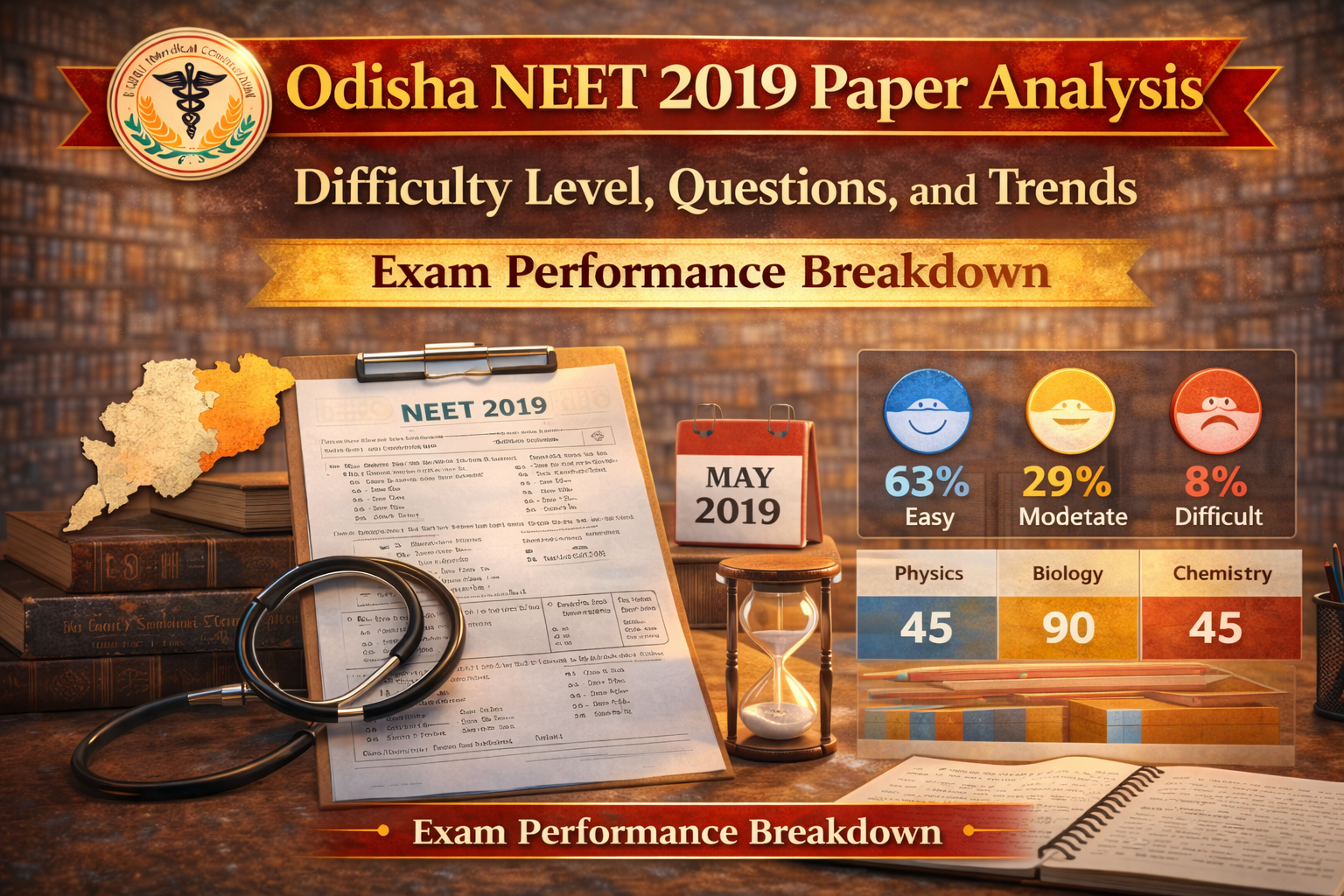
Total Questions: 180 MCQs
Subjects: Physics, Chemistry, Biology
Maximum Marks: 720
Duration: 3 hours
The paper was based on the NCERT syllabus of Classes 11 and 12, and largely contained questions made directly from these books.
Over 15 lakh students appeared for the exam, highlighting the increasing competitiveness among medical aspirants.
Overall Difficulty Level of NEET 2019
Based on expert analysis and student feedback, the overall difficulty level of NEET 2019 was easy to moderate.
But there were marked differences in the level of difficulty by subject.
Subject-wise Difficulty
Physics: Toughest section
Chemistry: Moderate difficulty
Biology: Easiest but lengthy
Physics, experts said, had quite a few numerical and conceptual questions that were tricky and required more in-depth understanding of the subject compared to rote memorization.
Physics Section Analysis
The most difficult part of NEET 2019 exam as per aspirants was the Physics section.
Key Observations
Conceptual-heavy and calculation-intensive nature of the majority of questions
Subjects were Mechanics, Electricity, Thermodynamics and Modern Physics
Some questions involved multi-step problem solving
Out of 45 questions in Physics:
Around 25 questions were moderate
About 9 were tricky
A few were considered easy
Students found the numerical parts time taking and needed very good clarity of concept.
Due to the complexity of Physics section, a large number of candidates weren't able to terminate the paper in the specified time.
Chemistry Section Analysis
NEET 2019 Chemistry section was a balanced and scoring.
Difficulty Breakdown
Many of the questions were directly derived from NCERT concepts
A huge part of the questions came from Physical chemistry
Organic and inorganic chemistry were moderately represented
Experts said the Chemistry section included:
18 easy questions
20 moderate questions
7 tricky questions
On the whole this section rewarded well-prepared students with high marks.
Biology Section Analysis
As per tradition, biology is the most critical subject of NEET and accounts for 50% of the total marks.
The Biology section of NEET 2019 had the following:
45 questions from Botany
45 questions from Zoology
The Biology section was feeler but longest, students also reported that original essay The hardest.
Important Topics Covered
Key chapters included:
Cell structure and function
Human reproduction
Genetics and molecular biology
Ecology
Microbes in human welfare
Most of the questions were directly from NCERT syllabus which made it easy for those who were more focused on textbook based preparation.
Question Trend in NEET 2019
NEET 2019 : Knowing the trend for each question is a crucial and important task.
Here are few key observations based on NEET 2019 question paper.
NCERT-Based Questions
Many of the questions were taken straight from NCERT textbooks.
Almost 7–8 questions were similar to last years papers or directly from the NCERT mill.
Conceptual Understanding
A lot of questions needed the application of concepts rather than rote memorization.
This was especially true in Physics and also some bits of Chemistry.
Even Distribution Between Class 11 and 12
Even better, questions were as results of each classes the students needed enough generalization.
Increasing Analytical Questions
A higher number of questions in NEET 2019 were analytical and reasoning based than in the previous exams.
Expected Cutoff Trends
Based on the previous year's NEET, there are predictions that 2019's expected qualifying cutoff would be somewhere around 125 to 135 marks for general category.
The cutoff needed for admission to medical colleges was much higher however.
Approximate Admission Cutoff Trends
Government medical colleges: 550–600 marks
Private medical colleges: 450–500 marks
These were the cutoff levels showed fierce competition among aspirants.
Function of NMC in Medical Education
The National Medical Commission has governing powers over medical education in India.
The NMC plays a key role in:
Approving medical colleges
Setting education standards
Regulating foreign medical graduates
Ensuring transparency in medical admissions
Medical students who wish to study abroad will have to follow NMC guidelines.
Importance of Global Recognition
The international recognition of universities is undoubtedly of immense significance for students who choose to pursue medicine abroad.
WDOMS Listing
World Directory of Medical Schools — a list of recognized medical universities worldwide.
This directory comprises universities, which are eligible for international medical licensing exams.
WHO Standards
And the education institutions mentioned are being validated by someone credible like the World Health Organization — and we want to get into every undergraduate, graduate and professional local healthcare facility around the world.
Medical degrees become accepted worldwide, as these organizations grant their recognition credentials.
Awesome Alternatives in MBBS Abroad To Choose For Your Career
Many students looking to study medicine abroad dance between these lines, due to the cut-throat competition in India.
Popular Destinations Include
Russia
Kazakhstan
Philippines
Little introducing here because in the last few years, MBBS in Georgia have become one of the most trending destinations for Indian Students due to:
Affordable tuition fees
English-medium programs
Globally recognized universities
Modern medical infrastructure
These allow Georgia to be a better alternative for students who qualify NEET but fail to find the admission seat in Indian medical colleges.
Importance of NEET Rank Predictor
Students who had given their NEET exam use tools like NEET Rank Predictor to estimate their All India Rank.
A NEET Rank Predictor assists students:
Predict rank based on score
Chances for Admission in Government College
Explore private college options
Think about MBBS in foreign countries like Georgia
Plans create immense packages of all these tools that help aspirants in planning their medical career better.
Odisha NEET 2019 Analysis: Lessons to be Learned
There is a lot that can be derived from the NEET 2019 paper analysis for all future aspirants.
Strong NCERT Preparation Is Essential
The majority of the questions are linked to NCERT concepts.
Conceptual Clarity Matters
Focus on mastering concepts, not memorization of facts.
Time Management Is Critical
Biology is long, whereas Physics is calculation-intensive.
Practice Previous Year Papers
It trains students to how questions will be asked, the level of difficulty in exams that they would face.
Conclusion
The analysis of Odisha NEET 2019 paper will help candidates to understand the difficulty level, patterns of questions and subject-wise trends in the exam.
Overall the paper was easy to moderate, in terms of physics as the most difficult section, and biology as the easiest but time consuming section.
Students preparing for future exams can use these patterns to analyze their performance and build better preparation strategies. Aspiring students can also use tools like the NEET Rank Predictor to assess their rank and further plan their admission journey.
Students also need to remain apprised of regulations set by the National Medical Commission and check whether any international medical university that they enrol into— particularly if it is for MBBS in Georgia—is recognized on global directories including WDOMS and supported by international standard promoted by organizations like WHO.
The NEET exam presents numerous challenges for students, but with careful preparation and planning, aspirants can overcome these obstacles and join the ranks of future medical professionals.