NEET vs Other Medical Entrance Exams — Major Differences
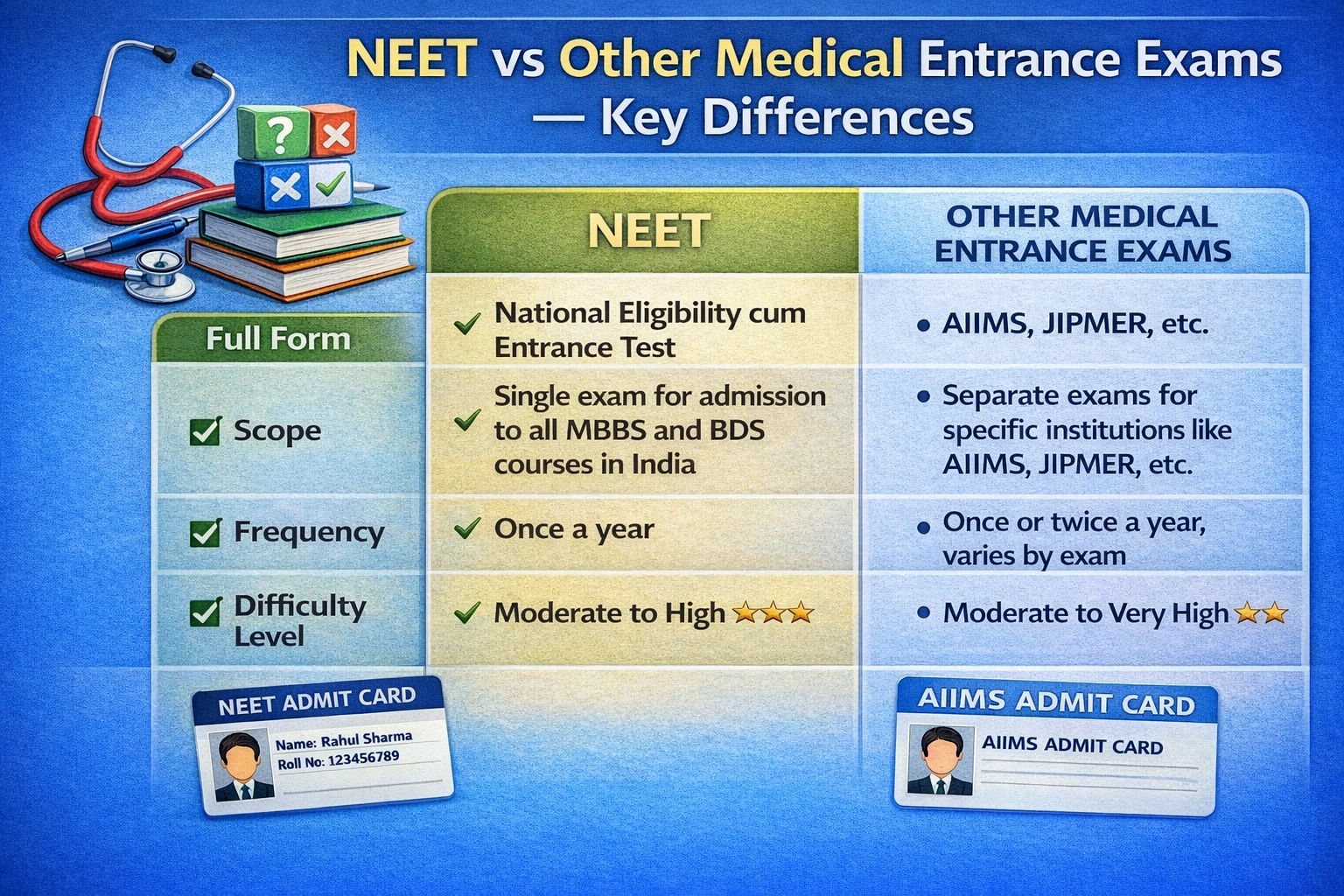
NEET vs other medical entrance exams: As students look to build a career in medicine, they often need to understand the difference between NEET and other medical entrance exams. NEET (National Eligibility cum Entrance Test) serves as the primary entrance exam for MBBS and BDS in India, but there are many other exams and pathways worldwide.
This article is a complete comparison chart detailing NEET and other medical entrance examinations to help you make informed choices in your career. It further gives insights on utility of tools such as a NEET Rank Predictor and about the regulatory boards like National Medical Commission (NMC), World Directory of Medical Schools (WDOMS), World Health Organization (WHO) etc.
What is NEET?
NEET is the single national-level entrance examination for undergraduate courses (MBBS, BDS and AYUSH) in India.
Key Features of NEET
Conducted at a national level
Compulsory for every medical college in India
Covers Physics, Chemistry, and Biology
Offline (pen-and-paper) exam
That is the reason why, NEET is one of the most critical exam for Indian aspirants as all the medical colleges in India are approved by the National Medical Commission.
All Indian Medical Admission Test
In the past, there were different entrance tests in India but currently only NEET is applicable for most of them.
Before NEET
AIIMS MBBS Entrance Exam
JIPMER Entrance Exam
These exams have now been combined into a single NEET exam, which will solely be taken for medical admissions in India.
Medical Entrance Exams Abroad
Another exam for students seeking to study medicine abroad, but in a different country.
MCAT (USA, Canada)
A standard requirement for medical schools in the United States and Canada
Tests critical tinking, biology, and chemistry reasoning
UCAT (UK)
Used by UK medical schools
Designed to assess aptitude, reasoning, and decision-making
BMAT (UK, some universities)
Tests scientific knowledge and problem-solving
The format, syllabus, and purpose of these exams are markedly different from NEET.
NEET vs Other Exams: A Brief Comparison
Exam Purpose
National Level Medical Entrance Exam (NEET) for undergraduate medical science courses MBBS/BDS in India
MCAT: For MD equivalent postgraduate medical programs abroad
UCAT/BMAT: Getting into undergraduate medicine in the UK
NEET is unique because it is the only entrance exam under which candidates can get direct entry into MBBS after their Class 12.
Eligibility Level
NEET: After 12th grade
MCAT: Once you have a bachelor’s degree
UCAT/BMAT: After 12th grade
This means NEET is one of the earliest gateways to a medical career.
Exam Pattern
NEET:
Subjects: Physics, Chemistry, Biology
Objective questions
Offline mode
MCAT:
Includes reasoning and analytical skills
Computer-based
UCAT/BMAT:
Concentrate on aptitude and logical reasoning
Computer-based
Difficulty Level
NEET: Concept-based with high competition
MCAT: More analytical and reasoning-focused
UCAT / BMAT: Focus on speed and aptitude
These exams require different approaches to preparation.
Acceptance and Recognition
India
For all medical colleges recognized by the National Medical Commission (NMC), NEET is a must.
Abroad
must be listed in the World Directory of Medical Schools
So this must be with standards from the World Health Organization
Even students who plan to study abroad have to ensure their student institution is recognized.
NEET Rank Predictor: Its Importance in Comparison
The NEET Rank Predictor is used to check students' probability in the competitive system of India.
Benefits
Predict the expected rank versus marks
Aids you in comparing opportunities in India vs outside
Assists in planning backup options
This tool can help students who are in a dilemma whether to pursue MBBS India or abroad.
Advantages of NEET
Common exam for all medical colleges in India
Transparent and standardized process
MBBS from Class 12 directly.
Widely recognized
Advantages of Studying Abroad
Lower competition in some countries
Access to global exposure
Chance to get admission in World Directory of Medical Schools accredited universities
Alignment with World Health Organization standards
However, students need to check the National Medical Commission eligibility for practicing in India after graduating.
Which Option Should You Choose?
Choose NEET if:
You want to study in India
You set target for government medical colleges
You prefer a cost-effective education
Consider Other Exams if:
You plan to study abroad
You are educated* on data until 10/2023
You want global exposure
Common Misconceptions
NEET is the single route to becoma a doctor
No need to proof-study abroad
Actually, there are several routes to follow but all of them have a proper planning and verification check according to National Medical Commission, World Directory of Medical Schools & World Health Organization guidelines.
Conclusion
National Eligibility cum Entrance Test or NEET is the most vital medical entrance exam conducted nationally for MBBS course after 10+2 in India. But exams such as MCAT, UCAT and BMAT are gateways to International medical education.
It is essential to know the eligibility, exam pattern, and career pathways to make the right choice. And validating colleges through the National Medical Commission, the World Directory of Medical Schools and the World Health Organization ensures a safe path to a medical career.
These different options require you to consider your own goals, background of preparation, and future vision for yourself as a physician.