Detailed NEET Chemistry Exam Pattern 2025
Chemistry is important for your total NEET score. Chemistry is the “make or break” factor between average and exceptional ranks, though Biology has the max weightage. To devise an impactful preparation plan, it is mandatory.
This comprehensive guide will provide you with an in-depth understanding of the NEET Chemistry pattern 2025 coupled with preparation strategies, scoring techniques, and how tools such as a NEET Rank Predictor help in this process. You will also learn how institutions like the National Medical Commission (NMC), World Directory of Medical Schools (WDOMS), and World Health Organization (WHO) relate to medical career.
Overview of NEET Chemistry Section
NEET Chemistry Section: After getting the familiarity of the overall examination, it is time we step into the syllabus for Chemistry.
Key Highlights
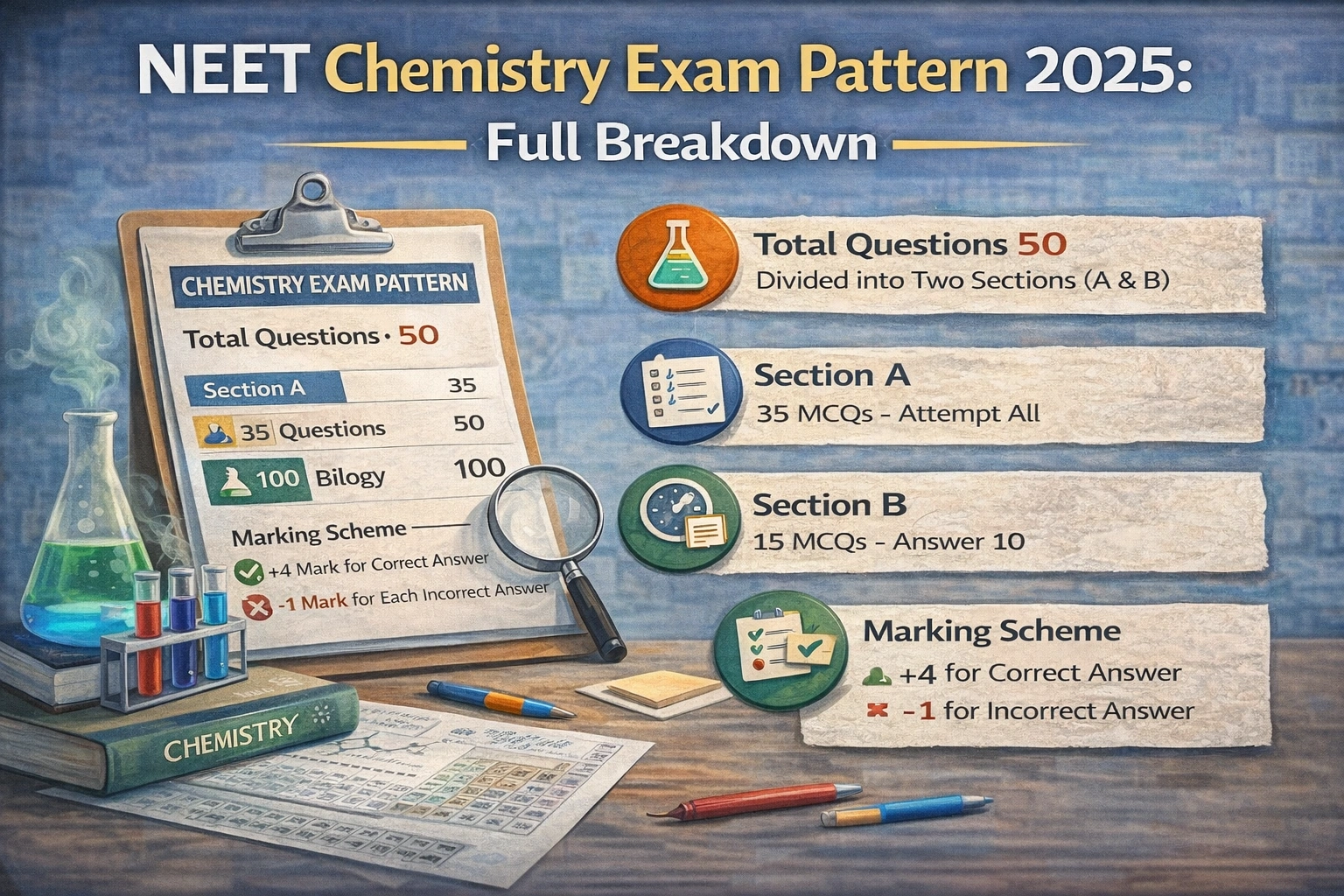
Total Questions: 50
Questions to Attempt: 45
Total Marks: 180
Type: Multiple Choice Questions (MCQs)
Section Division
Section A: 35 compulsory questions
Q. 15 questions of Section B, attempt any 10.
This flexible system allows students to choose the questions that play to their strengths.
Marking Scheme for Chemistry
Correct Answer +4 marks
-1 for every wrong answer
No marks for unanswered questions
This means accuracy is very, very important —especially with the tough Organic and Physical Chemistry questions.
Chapter-Wise Distribution
Chemistry NEET has three broad segments of syllabus.
Physical Chemistry
Numerical-based questions
Focus on formulas and calculations
Organic Chemistry
Reaction mechanisms and concepts
Application-based questions
Inorganic Chemistry
Theory and memory-based
Mostly NCERT-focused
The contribution of each section is almost equal, although allocation might vary slightly every year.
B) IMPORTANCE OF SECTION A, B STRATEGY
Section A (Compulsory)
Attempt all 35 questions
Focus on accuracy
Section B (Optional)
Attempt only 10 out of 15
Choose easier and familiar questions
Strategy
Quickly scan Section B
Avoid difficult or confusing questions
Maximize score by smart selection
Examination from the perspective of Chemistry in NEET
Chemistry is relatively moderate in difficulty.
Physical Chemistry: Moderate to tough
Organic Chemistry: Moderate
Inorganic Chemistry: Easy to moderate
If prepared in the right manner, Chemistry can be a scoring subject owing to this balance.
Impact of NEET Chemistry Pattern on Preparation Strategy
The pattern helps you be set up for success.
Focus on NCERT
And the Inorganic Chemistry questions are mostly out straight from NCERT.
Practice Numericals
Numerical practice is very important for Physical Chemistry.
Concept Clarity in Organic
Avoid rote learning. Focus on understanding reactions.
Regular MCQ Practice
It is important to practice minimum 80–100 Chemistry questions daily.
After evaluating the mock test scores, you can use a NEET Rank Predictor to check how did you perform in Chemistry and what is your overall rank.
Time Management Strategy for Chemistry
The time suggested for Chemistry during the examination is 45–50 minutes.
Suggested Approach
Start with Inorganic (quick scoring)
Move to Organic
Attempt Physical Chemistry last
These strategies help to gain confidence and save time.
Common Mistakes in Chemistry Section
Ignoring NCERT textbooks
Not practicing enough numericals
Memorizing without understanding
Not strategizing, attempting all questions in Section B
Steering clear of these blunders can markedly improve your score.
NEET Rank Predictor and its Role in Chemistry Analysis
One such tool is NEET Rank Predictor which provides you insight about the weightage of your Chemistry score in the overall rank.
Benefits
Identifies strong and weak areas
Helps improve subject-wise performance
Tracks progress over time
By using it consistently you can plan better and optimize your performance.
SMS in NMC, WDOMS and WHO
NEET score end up going on to medical school, governed by relevant organizations.
National Medical Commission (NMC)
There’s an approval for medical colleges in India.
World Directory of Medical Schools (WDOMS)
Lists globally recognized medical institutions.
World Health Organization (WHO)
Establishes global benchmarks for health education
So, I hope that makes it easier to understand these bodies and this will help you in making good decisions for your medical career.
Best Preparation Plan for Chemistry
Daily Plan
2–3 hours of Chemistry study
80–100 MCQs practice
Revision of formulas and reactions
Weekly Plan
1 sectional test
1 full-length mock test
Analysis using NEET Rank Predictor
Last Month Strategy for Chemistry
Revise NCERT thoroughly
Pay attention to key reactions and formulas
Attempt mock tests regularly
Avoid new topics
Revision on a regular basis, and no skipping is the secret to high scores.
Conclusion
The NEET Chemistry exam pattern will be 2025 as the test includes a well-balanced mix of conceptual, application and memory-based questions. You have 50 questions split into two sections, so knowing what to choose and being accurate are critical for increasing your overall score!
Using these aspects of preparation, including the NEET Rank Predictor along with aligning your study habits to match the exam pattern and NCERT based practice, you can ace Chemistry. Combined with this knowledge of international and national guidelines, insight into the functions of organizations such as the National Medical Commission, World Directory of Medical Schools and World Health Organization helps ensure your preparation is in alignment with long-term medical career plans طول عمر طبيب.
In NEET 2025, a good strategy in Chemistry can either score you well or fetch you an outstanding rank.