Analysis of NEET 2019 Question Paper with the Most Important Topics
The National Eligibility cum Entrance Test (NEET) serves as the primary entrance examination for students aspiring to pursue MBBS and other medical programs across India. Every year thousands of candidates take this competitive exam to try and get a limited number of seats in medical colleges.
One of the best strategies for NEET preparation is solving past years’ question papers. The NEET 2019 question paper holds paramount importance as it offers valuable information regarding exam pattern, subject wise difficulty level and commonly asked topics.
Even after the exam, several aspirants use tools such as the NEET Rank Predictor to gauge their expected rank and help them with going through admission into medical colleges.
Students who are unable to secure their seat in a medical college as the competition is overwhelming for them often explore alternate options like mbbs in georgia which comes with international exposure and recognition from global organizations such as the World Health Organization. Many of these universities are listed in the World Directory of Medical Schools and follow regulations recognized by the National Medical Commission, making it easier for Indian students pursuing education overseas.
So knowledge of the NEET 2019 paper structure will help students enhance their preparation and score better in upcoming tests.
NEET 2019 Exam Pattern Overview
Before we proceed to analyzing the question paper, let us keep in mind the NEET 2019 exam pattern.
Section | Number of Questions | Marks
Physics | 45 | 180
Chemistry | 45 | 180
Biology (Botany + Zoology) | 90 | 360
Total | 180 | 720
Important aspects of the exam pattern were:
Each question carried 4 marks
Negative marking: -1 for each incorrect answer
The exam duration was 3 hours in total
It is due to this marking system that students need to focus on accuracy and concepts instead of solving blindly.
Subject Wise Difficulty Level
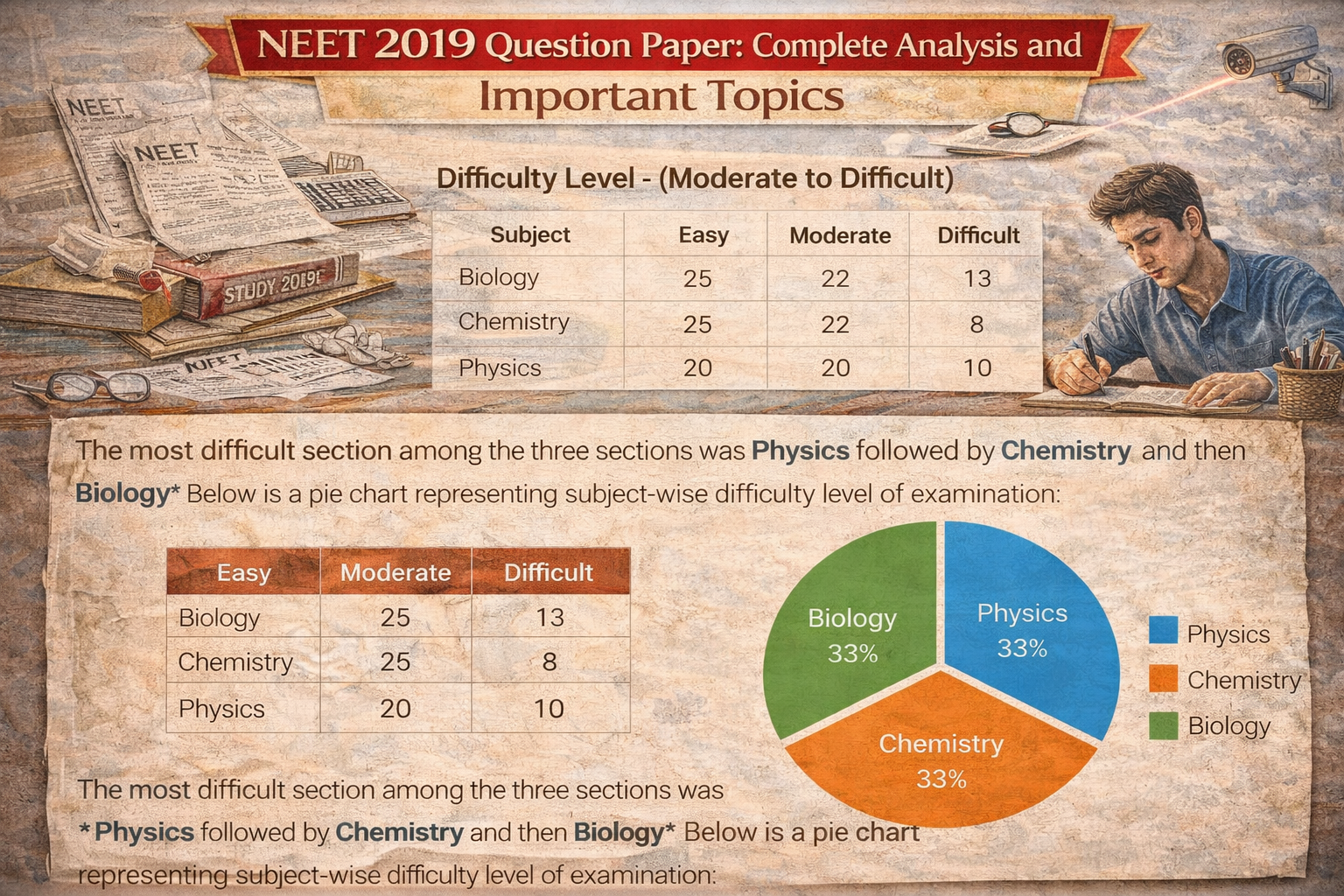
According to most experts and top coaching institutes, the overall difficulty of NEET 2019 was moderate.
Physics
Physics was moderate to difficult compared to other subjects.
A lot of the questions involved conceptual understanding and solving numerical problems.
There was a heavy emphasis on topics like mechanics, modern physics and electrostatics.
Chemistry
The chemistry section was considered the most straightforward part of the exam.
Most of the questions were directly taken from NCERT textbooks, and well-prepared students were able to score high marks.
The section had a fair distribution of organic, inorganic and physical chemistry.
Biology
Biology was moderate and largely based on the NCERT syllabus.
Since Biology contributes to 50% of the total marks, students who scored high in this subject significantly improved their final score.
Many questions were direct and concept based rather than numerical.
NEET 2019 Physics Important Topics
The Physics questions in NEET 2019 were from multiple chapters.
Mechanics
Key topics included:
Laws of motion
Work, energy and power
Rotational motion
Gravitation
Mechanics consistently contributes a large number of questions in NEET exams.
Modern Physics
Modern physics is regarded as a scoring topic.
Key areas included:
Photoelectric effect
Nuclear physics
Atomic structure
Students who had prepared these topics thoroughly found them relatively easy.
Electrostatics and Current Electricity
There were also questions based on:
Electric fields
Potential difference
Circuit analysis
NEET 2019 Chemistry Important Topics
Chemistry questions were mostly NCERT-based, making it easier for students who followed the textbooks carefully.
Organic Chemistry
Important topics included:
Hydrocarbons
Aldehydes and ketones
Alcohols and ethers
Biomolecules
Organic chemistry required understanding reaction mechanisms and concepts.
Inorganic Chemistry
Most questions were directly based on NCERT facts.
Key topics included:
Periodic table
Chemical bonding
Coordination compounds
Students who memorized important reactions and concepts performed well.
Physical Chemistry
The numerical based questions were mainly from:
Chemical equilibrium
Thermodynamics
Solutions
These questions required formula-based calculations.
NEET 2019 Biology Important Topics
Biology had the highest number of questions (90) in the exam.
Human Physiology
This section included many questions from topics such as:
Digestion and absorption
Respiration
Nervous system
Circulatory system
Human physiology is one of the most significant units in NEET Biology.
Genetics and Evolution
Genetics is another high-weightage topic.
Important subtopics included:
Mendelian genetics
DNA replication
Molecular genetics
These concepts require strong conceptual understanding.
Plant Physiology
Important areas included:
Photosynthesis
Plant hormones
Plant growth and development
Ecology and Environment
Environmental topics are often scoring areas.
Questions commonly come from:
Ecosystems
Biodiversity
Environmental issues
NEET 2019 Question Paper — Important Observations
The NEET 2019 question paper analysis reveals several important insights for future aspirants.
NCERT Is the Most Important Source
Many questions across subjects, especially Biology and Chemistry, were directly based on NCERT textbooks.
Students who thoroughly studied NCERT had a significant advantage.
Conceptual Understanding Is Essential
While some questions were straightforward, many required logical thinking and conceptual clarity.
High scores in NEET depend not only on memorization but also on understanding concepts.
Time Management Matters
The exam contains 180 questions, so students must manage their time efficiently.
Many successful candidates follow a strategy such as:
Attempt Biology first
Then Chemistry
Finally Physics
Benefits of NEET Question Paper Analysis for Students
Students can benefit from analyzing previous question papers in several ways.
Understanding Exam Trends
Students can identify frequently asked topics and focus their preparation accordingly.
Improving Exam Strategy
Practicing previous papers helps students learn how to manage time during the exam.
Estimating Performance
After attempting mock tests or practice papers, students often use the NEET Rank Predictor to estimate their expected rank and evaluate admission possibilities.
Why Many Students Pursue MBBS Abroad
Even after qualifying NEET, many students are unable to secure a medical seat in India because of extremely high competition.
This has increased interest in international medical education.
For Indian students, one of the popular choices is mbbs in georgia because universities provide affordable tuition fees and globally recognized medical degrees.
Many of these universities are:
Recognized by the World Health Organization
Listed in the World Directory of Medical Schools
Approved by the National Medical Commission
Graduates can later appear for medical licensing examinations to practice medicine in different countries.
Conclusion
The NEET 2019 question paper analysis is helpful in understanding the exam pattern, difficulty level and key topics important for preparation.
The exam consisted of 180 questions from Physics, Chemistry and Biology, with the highest weightage given to Biology. Physics was considered the most difficult section, while Chemistry was comparatively easier because it mainly included NCERT-based questions.
Students preparing for upcoming NEET exams should focus on previous year question paper analysis, mock tests and conceptual clarity to improve their chances of success.
Many aspirants also use tools like the NEET Rank Predictor to estimate their expected rank and plan their admission strategy.
For those who cannot secure a seat in India, options like mbbs in georgia are available through universities recognized by organizations such as the World Health Organization, the World Directory of Medical Schools and the National Medical Commission.
Ultimately, consistent preparation, conceptual knowledge and effective exam strategy remain the key factors for success in NEET.