NEET 2017 Cut Off Marks: General, OBC, SC & ST Categories
The National Eligibility cum Entrance Test (NEET) is the national level entrance exam for students seeking MBBS and BDS admissions in India. Numerous aspirants sit for this competitive examination each year hoping to gain admission into the leading medical institutes. NEET cutoff marks are the most significant thing when it comes to understanding a candidate's performance in the exam and his prospects for getting admission.
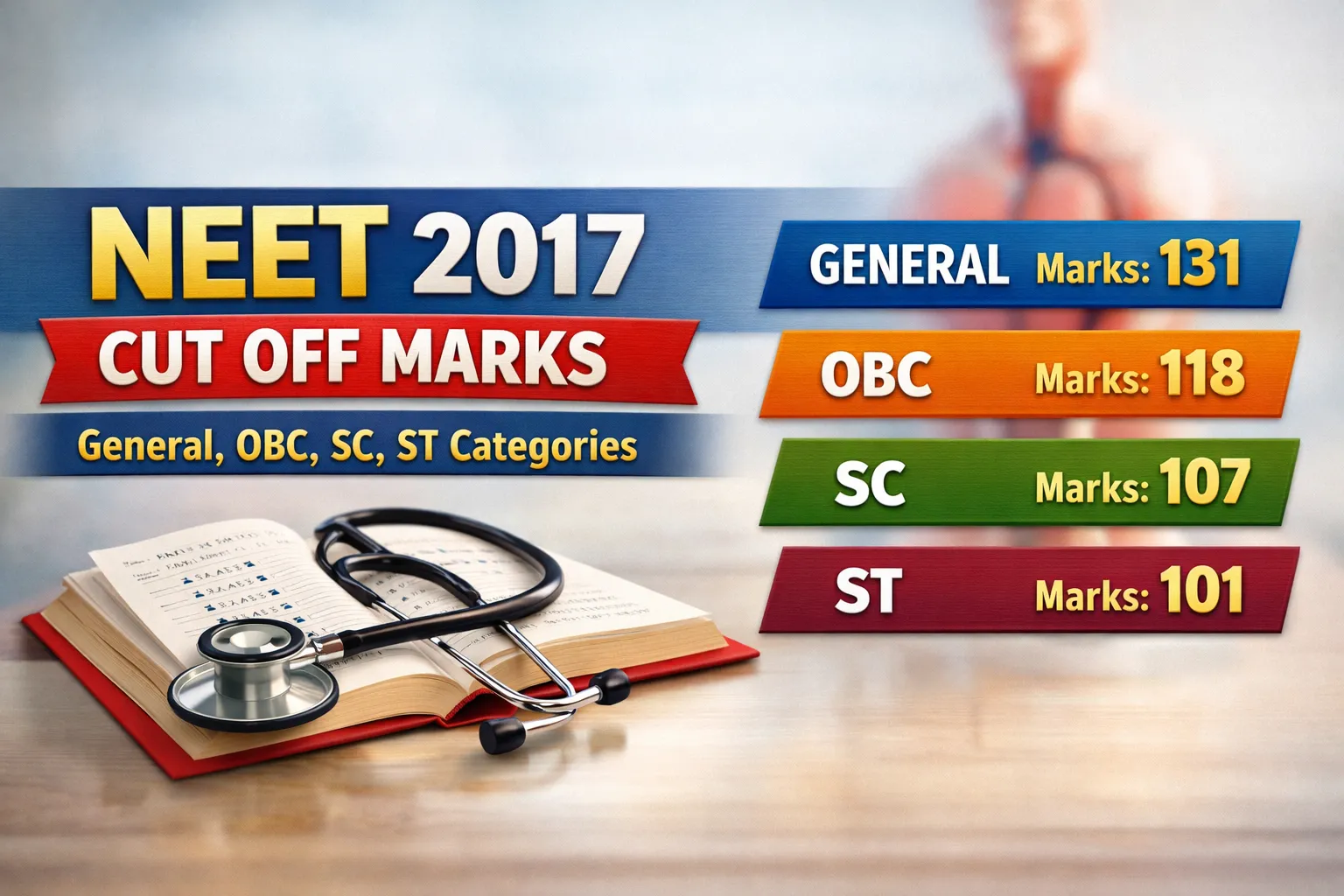
NEET 2017 cut off marks were different for each category of the candidate such as General, OBC, SC and ST. These were based on percentage scores and how hard the actual exam was.
NEET aspirants these days often go through previous years cut off trends and gauge their performance via a NEET Rank Predictor. These tools assist aspirants in calculating their expected rank and analyzing the possibility of acquiring admissions to a medical college.
In this article we will discuss the NEET 2017 cut off marks for various categories, trends and how students can use them to prepare better.
General Info about the NEET 2017 Exam
NEET 2017 was a national-level medical entrance test for admission into undergraduate medicine (MBBS) and dental college (BDS) courses in India.
It consisted of 180 multiple-choice questions across three subjects:
Physics – 45 questions
Chemistry – 45 questions
Biology – 90 questions
It was a total of 720 marks and the marking scheme was:
Correct answer: +4 marks
Incorrect answer: –1 mark
After the announcement of results, students calculates their scores and predicated their rank with NEET Rank Predictor.
NEET 2017 Qualifying Marks (Category Wise)
NEET cut off is calculated in the form of percentile and differs for each category.
Here is the NEET 2017 qualifying cut off marks for official(NTA) category-wise:
| Category | Percentile | Marks Range |
|---|---|---|
| General | 50th percentile | 697 – 131 |
| OBC | 40th percentile | 130 – 107 |
| SC | 40th percentile | 130 – 107 |
| ST | 40th percentile | 130 – 107 |
These marks are the minimum qualifying marks to be able to appear in the counselling process for admission into medical colleges.
Candidates securing lower than these marks are not entitled to entry in MBBS or BDS programmes via NEET.
Determining the factors that impact NEET 2017 cut off
The cut off marks of NEET varies from year to year due to various reasons.
Difficulty Level of the Exam
In case the exam is tough, the cut off marks usually lowers. In case exam is easy, higher the cut off marks.
The NEET 2017 All India exam was of moderate difficulty level and hence, affected the cut off scores.
Number of Candidates Appearing
The cutoff is also determined based on the number of candidates taking the exam.
The competition surged as over 11 lakh candidates appeared for NEET 2017.
Multiple students check their possible rank as a form of analysis using a NEET Rank Predictor to know where they stand against the competitors.
Number of Available Seats
The cut off marks also depend upon the available MBBS and BDS seats in medical colleges.
In case of increase in the number of seats, there might be a minor decrease in cut off.
Reservation Policies
Policies to reserve for OBC, SC و ST categories are very important as they impact the category-wise cut off marks.
Such policies are designed to provide equal opportunities for students from diverse social backgrounds.
Government College Cut Off Trends
One must note that qualifying the NEET cut off does not mean he/she will get admission in a government medical college. Cut offs of government college are very much higher.
For example:
Top government colleges: 600–680 marks
Average state government colleges: 500–600 marks
Lower-ranked government colleges: 500–550 marks
Based on the expected score of students, a NEET Rank Predictor allows them to estimate their chances of getting admission.
NOTE FACE: Importance of Analyzing Previous Cut Off Marks
Understanding Competition
The cut offs from the previous years tells how competitive the exam is.
Setting Score Targets
Ensuring students have realistic score targets, which are based on previous trends.
Planning College Preferences
Cut offs analysis guides students to know which colleges are within reach.
NMC, WHO & WDOMS – Triad to Faculty in Medical Education
Once students clear NEET and get a qualifying score, they need to be careful with the selection of their medical colleges.
Make sure you also check that the chosen institution is recognized by most regulatory authorities.
NMC (National Medical Commission)
An apex authority in charge of overseeing medical education and ensuring compliance with training standards in Indian medical colleges, the NMC is responsible for regulating the practice of medicine.
It allows graduates of NMC-recognized institutes to practice medicine in India.
WHO (World Health Organization)
The WHO operates globally to enhance the pace of healthcare systems, admission and recognition of medical institutions across the world.
Many medical universities are affiliated with WHO, which is trusted to take its command in our educational omnibuses.
World Directory of Medical Schools
The WDOMS has a worldwide database of accredited medical schools.
Generally, as long as a degree is listed in WDOMS, it will be accepted worldwide.
Students who are interested in pursuing medicine overseas must confirm that the university they aim to attend is NMC Approved, WHO-certified, and enrolled with WDOMS.
NEET Cut Off Data in Using Information for Preparation
Different students can design a good study Calendar by knowing previous cut off marks.
Set a Target Score
So, when aiming for the highest possible admission score aim to have a significantly higher score than the last cut off score.
Practice Mock Tests
It is advised to take mock tests regularly in order to improve the speed as well as accuracy.
Analyze Performance
Using a NEET Rank Predictor, calculate your expected rank after every mock test.
Focus on Weak Subjects
Find out weak spots and spend more time accordingly.
Here are some tips to score better than NEET Cut off
Strategies to score well in NEET which are useful for you.
Study NCERT textbooks thoroughly.
Go through last year’s NEET question papers.
Practice mock tests regularly.
Practice frequently the important formulas and concepts.
Use a NEET Rank Predictor to Check Your Progress
A committed approach and disciplined preparation can help achieve a high score.
Conclusion
NEET 2017 cut off marks help you understand the level of competition and minimum required scores to get medical admissions in India. The cut off is category wise—General, OBC, SC and ST —and depends on a number of parameters such as difficulty level of the exam, total number of candidates who appeared in it and seats available through it.
NEET aspiring students should take a look at old cut off patterns to make sure they have a feasible score target in mind, along with their strategies for prep. For example, aspirants can use the NEET Rank Predictor to know their expected rank and assess their performance.
After students clear NEET, they must also ensure that the medical colleges of their choice are recognized by NMC, acknowledged by WHO and listed in WDOMS.
Registering consistent practice, smart preparation approaches and an evident knowledge of cut off trends can bolster the chances of NEET aspirant to get admission in top notch medical colleges at pan India level. 🚀