Top 20 Most Important Questions Based on NEET 2018 Question Paper
The NEET 2018 examination continues to serve as a benchmark for medical aspirants preparing for NEET 2026. Reviewing past papers helps identify high-yield questions, recurring topics, and crucial themes. Alongside, using a NEET Rank Predictor allows students to estimate their All India Rank (AIR) based on practice tests or expected scores, aiding in admission planning and state/national quota strategies. Awareness of NMC, WHO, and WDOMS recognition is also essential for MBBS aspirants considering international medical education.
Importance of Identifying High-Yield Questions
NEET has over 15 lakh aspirants yearly, making it extremely competitive.
Biology: 360 marks; Physics & Chemistry: 180 marks each
Focusing on recurring subjects improves accuracy and time management.
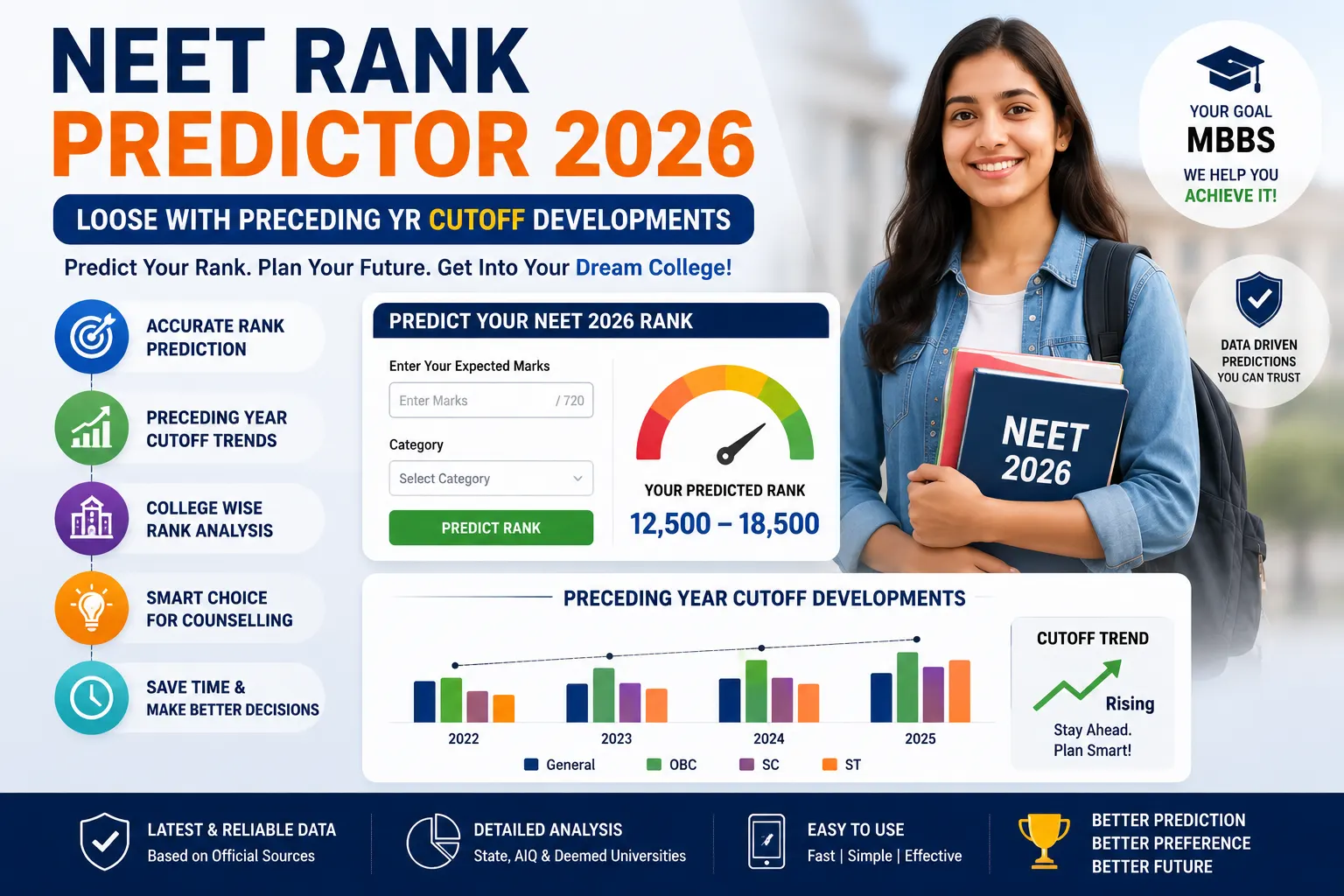
After practice, students can predict potential AIR using a NEET Rank Predictor.
Most Important Physics Questions
Key topics from NEET 2018:
Mechanics: Work, energy, power calculations, projectile motion, kinematics
Electrostatics & Current Electricity: Coulomb’s Law, Ohm’s Law, circuit analysis
Magnetism & Electromagnetic Induction: Forces on moving charges, Faraday’s Law numericals
Modern Physics: Photoelectric effect, nuclear reactions, energy calculations
Oscillations & Waves: Simple harmonic motion, wave interference, Doppler effect
Strategy:
Practice numericals thoroughly
Revise formulas daily
Solve previous NEET papers to identify patterns
Most Important Chemistry Questions
Physical Chemistry:
Chemical kinetics, Thermodynamics & equilibrium
Electrochemistry, Solutions
Organic Chemistry:
Hydrocarbons (Alkanes, Alkenes, Alkynes)
Alcohols, Aldehydes, Ketones
Substitution & addition reaction mechanisms
Inorganic Chemistry:
Periodic Table trends
Coordination compounds
Chemical bonding
Strategy:
Follow NCERT Chemistry strictly
Prepare reaction charts for quick revision
Solve different NEET numericals and theory questions from past years
Most Important Biology Questions
NEET 2018 biology carried 50% of total marks. NCERT mastery is critical.
High-Yield Topics:
Human Physiology: Circulatory, digestive, excretory, nervous, and endocrine systems
Genetics & Evolution: Mendelian genetics, evolutionary biology concepts
Plant Physiology: Photosynthesis, respiration, transport in plants
Ecology & Environment: Ecosystem interactions, biogeochemical cycles
Biotechnology: Genetic engineering and its applications
Strategy:
Highlight key NCERT lines
Practice diagram-based questions
Make flashcards for quick recall
Category-Wise and State-Wise Insights
Cutoffs differ by General, OBC, SC, ST categories
Top-performing states in Biology: Tamil Nadu, Karnataka, Kerala, Maharashtra
NEET Rank Predictor helps analyze AIR and category rank for counseling
NEET 2026 Preparation: How to Use These Questions
Prepare High-Yield Topics: Recurring areas like Physics–Mechanics, Modern Physics; Chemistry–Physical & Organic; Biology–Physiology & Genetics
Practice & Revise: Solve NEET 2018 questions and correct mistakes
Mock Tests: Simulate exam conditions and predict AIR with NEET Rank Predictor
NCERT-Based: Follow NCERT textbooks thoroughly
Global Awareness: For MBBS abroad aspirants, ensure WHO-approved and WDOMS listed colleges
Key Takeaways
NEET 2018 questions guide preparation and provide exam strategy
Physics: Concept clarity & numerical practice
Chemistry: NCERT mastery + problem-solving
Biology: Memory-based scoring; focus on diagrams & NCERT lines
High-yield questions offer efficiency and scoring advantage
Use NEET Rank Predictor to estimate performance
NMC, WHO, and WDOMS awareness ensures informed decisions for MBBS in India or abroad
Conclusion
NEET 2018 chapter-wise most important questions provide a roadmap for NEET 2026 aspirants. Practicing these questions, evaluating weak areas, and improving time management through a NEET Rank Predictor is essential. Consistent practice, NCERT command, and proper preparation strategy help secure top ranks both nationally and in state quotas, paving the way for a successful medical career.