Japan’s modern technology and highly regarded universities make it a sought-after location for many students pursuing international medical studies. In light of Japan's respected medical system, lots of students want to know, like many other inquiring minds, what degree in Japan is considered comparable to an MBBS degree, and whether international students can study medicine in Japan.
With respect to MBBS, the equivalent medical degree in Japan is called the Doctor of Medicine (MD). Unlike MBBS programs in India, Bangladesh, and Russia, Japan follows an integrated system of medical education, and that includes both undergraduate and professional training.
What Is the MBBS Equivalent Degree In Japan?
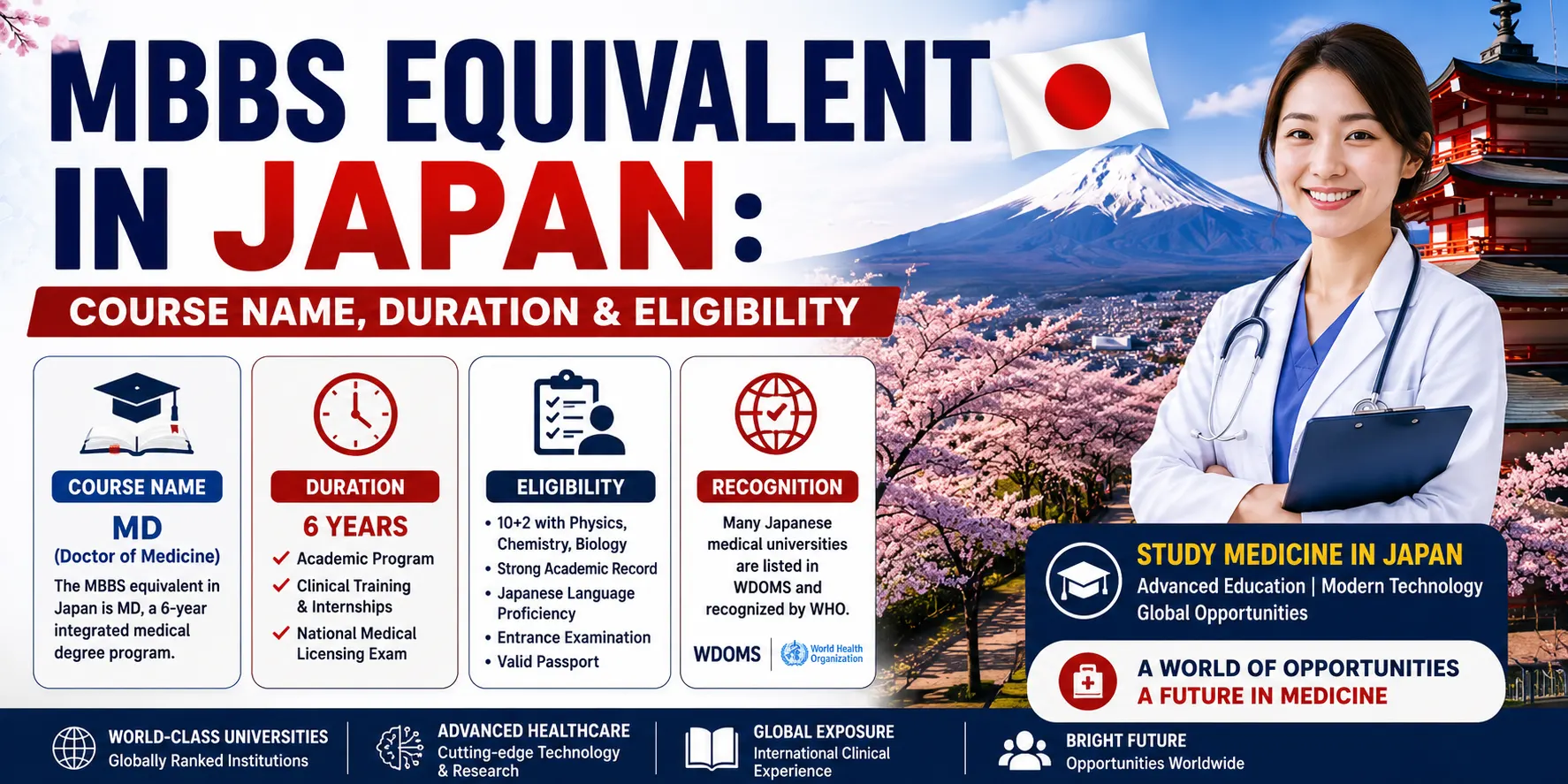
The Japanese equivalent of an MBBS degree would be the MD (Doctor of Medicine) degree, and that is the degree awarded by a recognized medical university after successfully completing a 6-year medical education program.
The program consists of:
- Fundamentals of medical sciences
- Clinical medicine
- Training in hospitals
- Research
- Practical clinical rotations
Once students complete the program and clear the National Licensing Exam, they can practice medicine in Japan.
Duration of Medical Course in Japan
The standard medical education in Japan lasts for:
- 6 Years Academic Medical Program
- Includes Clinical training and internships
- After which they’ll sit for the National Medical Licensing Exam
The duration of medical training is comparable to that of an MBBS program in most countries.
Criteria for International Students
For international students who would like to study medicine in Japan, some of the requirements include:
- Completion of higher secondary school & Higher secondary school level Physics, Chemistry, and Biology
- Submission of relevant academic documents & strong academic performance
- Language proficiency in Japanese
- Passing relevant entrance examinations
- Possession of a valid passport
If Indian students would like to practice their medical profession in India (after completion of their medical studies in Japan) they are required to sit and qualify for the NEET examination as per the National Medical Commission (NMC) directives.
Japanese Language Proficiency
Language is one of the barriers that international students planning to study medicine in Japanese universities face. This is largely attributed to the fact that most of the Japanese medical universities conduct their lectures in Japanese. Therefore, students are required to have:
- JLPT (Japanese Language Proficiency Test)
- Japanese language training
- High level of Japanese communication skills
Most of the medical universities that have their programs in the English language are very few.
Recognition of Japanese Medical Universities
Prior to applying to a university, students should confirm whether the university is recognized worldwide. Many Japanese medical universities are included in the World Directory of Medical Schools (WDOMS). They are also recognized by the World Health Organization (WHO).
Having recognition is beneficial for future certification exams, postgraduate studies, and the possibility of working as a medical professional in other countries.
Reasons for Studying Medicine in Japan
There are a number of reasons for students interested in medicine and healthcare programs why they consider Japan as one of their top options. These include:
- Cutting-edge advancements in healthcare technology
- Advanced healthcare systems and infrastructure
- Research advancements and opportunities
- Global exposure and highly ranked universities
Japan is recognized globally for its continuous advancements in healthcare and medical research.
Challenges for International Students
On the plus side, students also have to deal with:
- Significant language barriers
- High levels of competition for university admission
- Higher cost of basic necessities
- Few available English medium seats
- Adapting to a new culture
Planning and preparation before applying for medical education in Japan is imperative to international students.
MBBS Abroad Alternatives
Considering the language barriers, along with the few available seats for English medium courses in Japan, a lot of Indian students search for alternative options to MBBS abroad destinations like:
- Bangladesh
- Russia
- Kazakhstan
- Georgia
- Uzbekistan
- Nepal
Most, if not all, of these countries generally have less expensive tuition, offer English medium courses, and provide medical education and degrees that are recognized internationally.
Students can also utilize the NEET Rank Predictor to evaluate their admission chances and assess medical education opportunities both in India and abroad.
Conclusion
The equivalent of MBBS in Japan is the MD degree, which is conferred after the completion of a 6-year integrated medical education. For students who want to study medicine abroad, Japan has exceptional medical education, advanced healthcare technology, and great opportunities for medical research.
Still, the students have to critically think about the language barriers, how recognized the university is, the admission criteria, and licensing after their studies, among others, before getting accepted to universities. They can look up the NMC, WHO, WDOMS, and the official NEET Portal for guidance on medical studies abroad.