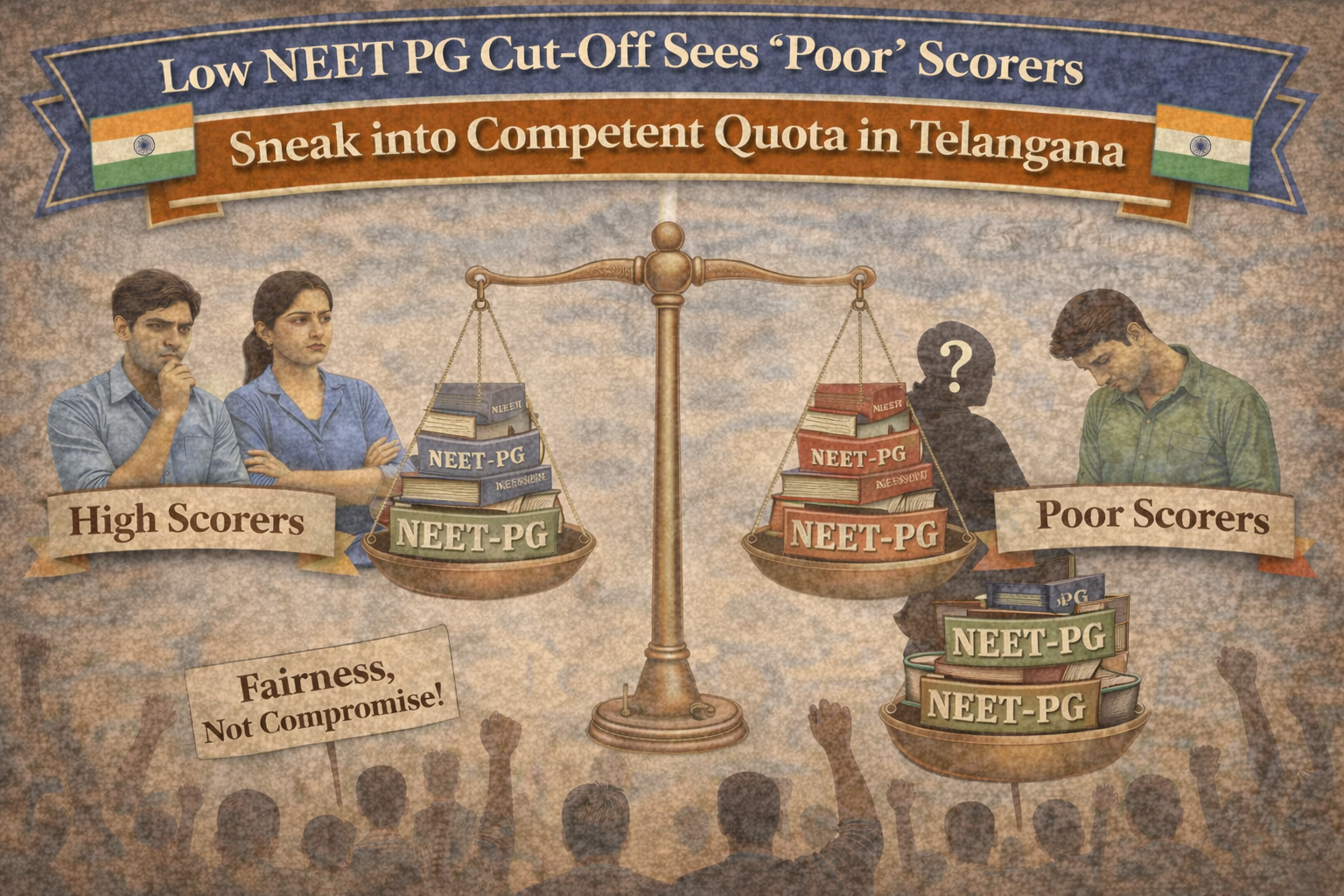
Telangana's Competent Quota is Boosted by 'Poor Scorers'
Hyderabad (Telangana) -- February 26, 2026 A significant fall in the cut-off scores of the NEET 2025 counselling allowed candidates with alarmingly poor marks to secure postgraduate seats under the Telangana State Competent Authority Quota, causing deep concern amongst medical professionals and students.
Data obtained from Kaloji Narayana Rao University of Health Sciences, the authority responsible for PG Medical seat allocation in Telangana, revealed that scores previously deemed far too low for entry into postgraduate studies have now been deemed to be eligible for counselling. Seats were ultimately allocated to candidates who scored barely higher than trivial levels.
Drastic Cutoff Drop - A Steep Decrease in Academic Standards
Admission to postgraduate medical seats traditionally hinged on a competitive score at the National Entrance Test for Postgraduates or National Entrance Test PG. To be eligible for admission, candidates must usually meet strict percentile cut-offs -- often near or at the 50th percentile in general category. This landscape has changed dramatically due to changes in the qualification norms and counseling rules for 2025-26.
According to KNRUHS's latest official data, the revised qualifying criteria allowed candidates scoring less that 100 marks out 800 (effectively a score of less than 13 percent) to be considered under the Competent Authority Quota for state quota. Amazingly, one candidate was able to secure a clinical orthopaedic seat with a reported just one mark.
This massive reduction of cut-offs has allowed a large number of seats to be filled -- approximately 84 % of the 333 PG Seats in Telangana. Previously, seats in the competent authority quota would be filled by candidates who scored well within higher merit brackets.
Competent Authority quota explained
The Competent Authority (CQ) is a state quota seat allocated by official state counselling authorities, in this case KNRUHS, based on merit, rank, and eligibility. These seats are different from management-quota, which is filled through separate processes, often involving higher payment, and from All India quota (AIQ),, that is allocated via the Medical Counselling Committee.
CQ was designed to ensure that seats are distributed based on merit at the state level, especially in government medical schools. The recent dramatic reduction of eligibility cut-offs have raised questions about whether quality, competency, and clinical readiness are still at the forefront when it comes to admissions.
Official Policy Shift & Rationale
The government authorities, such as the National Medical Commission and National Board of Examinations in Medical Sciences NBEMS, have defended this policy of reduced cut-offs as an administrative measure to prevent widespread waste of seats. After the first round of counselling, thousands of postgraduate seats in medicine remained vacant. This crisis is attributed by policymakers to the imbalance between the number candidates who meet traditional qualifications and the number seats available.
In an affidavit submitted to the Supreme Court of India by government officials, they stated that reducing the qualifying percentiles is a calibrated measure, intended to optimize seat usage and produce more specialist doctors in public and private medical institutes. They argued that this reduction reflects "a proportionate administration measure" and not a dilution in standards.
Critics argue that this move undermines the core philosophy of medical education which is rooted on clinical competence, shaped by merit and scientific rigour.
Critics Condemn Policy: Patient Safety is at Stake
Medical professionals, educators and other healthcare stakeholders have expressed concern about the implications of such low eligibility criteria. One of the most common arguments is that admitting doctors who have low academic scores -- sometimes as low as a single digit -- could compromise postgraduate training and clinical competence.
Doctors and specialists have stressed that postgraduate medical education is not only academic, but also heavily clinical and experiential. To maintain the high standards of specialist physicians, it is important to ensure that candidates have a solid foundation at the undergraduate level. This can be demonstrated by their NEET PG results.
One senior clinician, who requested anonymity for professional reasons, asked: "If candidates enter PG program scoring so low in NEET PG what assurance do we get that they can handle rigours clinical training or ensure safety of patients?"
Recent article on national medical issues highlighted the growing gap between merit-based seat allocation and administrative expediency. This gap could have far-reaching implications for healthcare quality, if not addressed.
Impact of Merit and Competition
One of the most fundamental criticisms of the revised policy is the impact it has on meritocracy - the principle that better-performing candidates should receive more opportunities, both with regard to seat allocation and training.
Prior to this policy change, only candidates who had a relatively high rank -- often in or above the top 100,000 -- could realistically expect to secure government quotas. Aspirants with scores below 200,000 and ranks above 200,000 are now able to get seats that were previously out of reach.
This has also undermined some commonly-used NEET rank predictor that many students and counselors rely on in order to forecast counselling outcomes. Even near-bottom rankings can result in seat allocations if cutoff scores drop unexpectedly. This makes traditional rank-based predictions less reliable.
Implications for Academics and Healthcare
This policy change in Telangana is not just about admissions dynamics. It reflects a larger systemic problem affecting postgraduate education in India.
Training Quality Issues
Critics point out that medical schools -- especially government institutions -- can struggle to train clinical staff whose academic foundation is weak. Postgraduate specialties require deep medical knowledge, rapid clinical reasoning, adaptability, and a high level of medical expertise. There are questions about whether candidates who were admitted under lowered criteria would meet these requirements.
Public Trust in Medical Education
Educators warn against the erosion of public confidence by the repeated lowering NEET PG qualification criteria. Parents and patients often associate higher cut-offs to stricter academic standards, but this is now being undermined by administrative expediency. There have been reports that similar changes to cut-offs occurred in previous years, indicating a pattern and not an isolated adjustment.
Professional Credibility
International recognition of medical qualifications in India is becoming more and more scrutinized. Databases such as the World Directory of Medical Schools, and global listings maintained World Health Organization catalog Indian medical institutions and their status of recognition. Although WHO does not set admission standards, broader recognition for medical programs is dependent on academic standards. Inadvertently, any perceived deterioration in student quality could affect perceptions of Indian postgraduate education around the world.
Voices of the Ground: Students, Teachers and Educators Speak
Students have expressed mixed reactions. Aspirants who scored well but lost their seats due to unexpected shift cuts expressed frustration and disappointment.
"Thousands of aspirants spend months, or even years, working to achieve high NEET PG scores in the hope of receiving specialist training. "But when seats are allocated to candidates with scores that are so drastically lower, this raises questions about unfairness," a candidate commented.
Some aspirants who have benefited from the lower cut-off point see this as a chance that was unexpected, but one that is clouded by uncertainty about their future career prospects.
Senior educators have also warned that while it is important to fill seats to maintain training workflows and to maintain the quality of the training, reforms other than cut-off reduction may offer better solutions. For example, a greater expansion of PG seating, targeted support for students who are financially disadvantaged, but academically capable, or scholarships to retain talent.
Policy Alternatives and Possible Reforms
Experts who advocate structural reform recommend options which do not compromise academic rigor.
* Capacity Expanding
Increasing the number PG seats by investing in infrastructure and faculty can balance demand, without lowering qualification standards.
* Financial Support Programs
Scholarships and fee subsides for deserving students with lower economic backgrounds could help these candidates access quality education.
* Transparent Models of Eligibility
Gradual eligibility criteria adjustments based on clear benchmarking and competency assessments, rather than blanket percentage drops.
Analysts in healthcare policy say that maintaining the credibility of postgraduate training is crucial to ensuring public trust and professionalism over the long term.
Conclusion: Balancing Standards With Seats
The ongoing debate about Telangana’s NEET PG Cut-off Reduction highlights a critical dilemma that India's medical system faces -- how to fill training seats while preserving integrity, competence, future clinical capabilities, and the next generation of doctors.
While administrative motives for preventing seat wastage may be understandable, the broader implications demand a more sustainable and strategic approach that respects merit and the sanctity and integrity of medical training. The medical fraternity is closely watching the debate as it continues in institutional, state and national forums, including judicial reviews and policy deliberations, to find the right balance between excellence and inclusion.