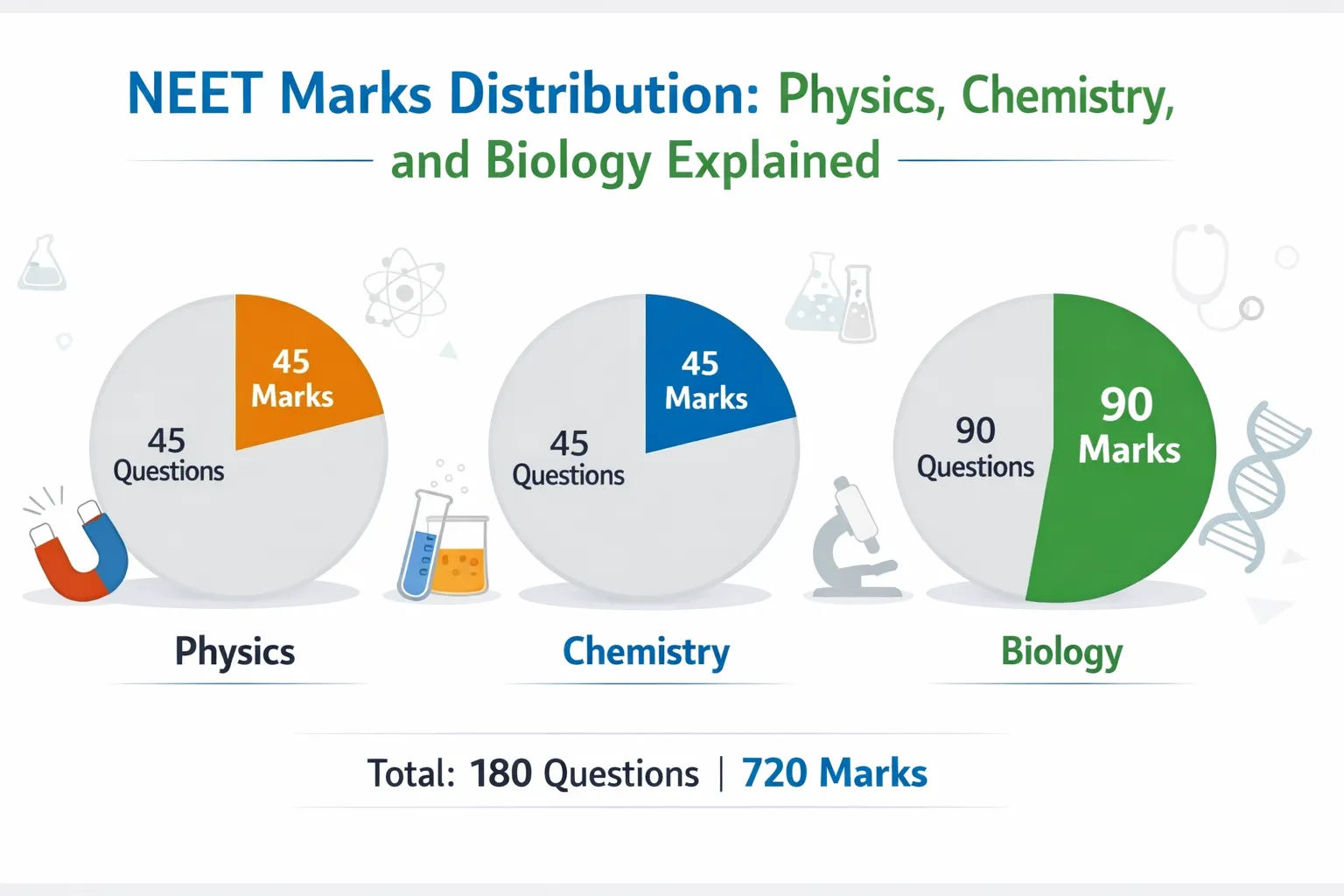
Detailed Marks Distribution of Each Subject: Physics, Chemistry, and Biology in NEET
NEET marks distribution information for every aspirant applying for a top rank. Since NEET is a competitive exam, so information regarding marks distribution between Physics, Chemistry and Biology helps you to plan out your preparation strategically and manage time wisely.
This comprehensive guide will discuss NEET marks distribution along with subject-wise weightage, a scoring strategy, calculator tools like a NEET Rank Predictor and organizations such as National Medical Commission (NMC), World Directory of Medical Schools (WDOMS), World Health Organization (WHO) and more that are relevant to your medical journey.
Total Marks and Exam Structure
NEET is for 720 marks.
Overall Distribution
Total Questions: 200
Questions to Attempt: 180
Each Question: 4 marks
To the correct answer, (+4), To every incorrect answer (-1)
Subject-wise Division
Physics: 180 marks
Chemistry: 180 marks
Biology (Botany + Zoology): 360_marks
Biology is the most important subject in NEET, carrying the maximum weightage.
Subject-Wise Marks Distribution
Physics
Total Questions: 50
Questions to Attempt: 45
Total Marks: 180
Physics is regarded as the toughest section in view of numerical and conceptual questions.
Key Focus Areas
Mechanics
Electrodynamics
Modern Physics
Strategy
Practice numericals regularly
Focus on concept clarity
No random guessing (Negative marking)
Chemistry
Total Questions: 50
Questions to Attempt: 45
Total Marks: 180
If prepared correctly, chemistry becomes a scoring subject.
Sections
Physical Chemistry
Organic Chemistry
Inorganic Chemistry
Strategy
Focus on NCERT for Inorganic
Practice reactions for Organic
Solve numericals for Physical
Biology (Botany + Zoology)
Total Questions: 100
Questions to Attempt: 90
Total Marks: 360
It forms 50% so it is a very important subject biology.
Key Focus Areas
Human Physiology
Genetics
Ecology
Plant Physiology
Strategy
Thorough NCERT reading
Regular revision
Practice diagram-based questions
Section-wise Pattern (Updated Format)
Each subject is divided into:
Section A
35 questions
All compulsory
Section B
15 questions
Attempt any 10
This gives you the freedom to choose questions as per whatever suits your preference.
How can marks distribution help your preparation
Understanding marks distribution helps you:
Prioritize high-weightage subjects
Allocate study time effectively
Build a balanced preparation strategy
For example:
Biology should get maximum time
Physics requires consistent practice
Chemistry needs conceptual clarity
Ideal Score Distribution Strategy
If you would like to get a high rank, target:
Biology: 320–350
Chemistry: 140–160
Physics: 130–150
This can lead you to a safe score of 600+ which is good for decent gove. colleges.
This helps them realize what is the effect of their subject-wise scores on the overall rank which can be achieved using a NEET Rank Predictor.
Time Allocation Strategy
Daily Study Plan
Biology: 3–4 hours
Chemistry: 2–3 hours
Physics: 2–3 hours
Weekly Plan
Full syllabus coverage
Regular mock tests
Performance analysis
Success is about a balanced preparation.
Common Errors in Marks Distribution Strategy
Ignoring Physics due to difficulty
Over-focusing only on Biology
Not practicing enough MCQs
Skipping revision
All of these mistakes can hurt your performance.
Role of NEET Rank Predictor
What does NEET Rank Predictor do for you:
This is the final answer key for each subject.
Analyze subject-wise performance
Set realistic goals
You can use it when analyzing mock tests.
NMC, WDOMS and WHO: Trained on October 2023
Your NEET score opens the doors to medical courses, regulated by some of the most prestigious controlling bodies.
National Medical Commission (NMC)
Regulates and approves colleges for medical education in India.
World Directory of Medical Schools (WDOMS)
Lists recognized medical colleges worldwide.
World Health Organization (WHO)
Maintain international standards of health care education
How Marks Distribution Affects Rank
Higher Biology score significantly enhances overall marks
Good Performance in All Subjects Leads to Better Rank
Performance below average in one subject can bring total score down
One subject; consistency is the king, and perfection is worthless.
Final Preparation Tips
Focus on NCERT textbooks
Practice mock tests regularly
Revise frequently
Avoid negative marking
Conclusion
The marks distribution in NEET is evident that Biology has the highest weightage followed by Chemistry and Physics respectively. Good preparation Planning should aim at scoring well in Biology whereas keeping the performance level good also in the other two subjects.
However, with a clear understanding of the exam structure, consistent practice, and tools such as a NEET Rank Predictor at your disposal, you can increase your chances of obtaining a high rank. In addition to this, knowledge of organizations like the National Medical Commission, World Directory of Medical Schools and World Health Organization helps mold your preparation toward a long-term goal in medicine.
To achieve success in NEET, the emphasis should be on a balanced approach with all three subjects.