Syllabus Completion Tracker in a Tool
Hard work is a prerequisite to qualify for the NEET exam. It takes strategy, planning and ongoing tracking of your progress. It is seen that a wide majority of students devote months studying subjects like Physics, Chemistry, and Biology but often fail to realise if they have actually been able to cover the syllabus or not. This is where digital and analytical tools really prove their worth.
One of the most significant aims in NEET preparation is tracking your syllabus completion. Without tracking students’ progress, they may either waste too much of their time on some chapters or skip them altogether. This is where aspirants are able to obtain real-time monitoring of their preparation based on modern-day study tools, practice platforms and analytics such as a NEET Rank Predictor.
Embarking on medical education is usually a great challenge for students aspiring to get into medical colleges approved by NMC which are enlisted in worldwide directories such as WDOMS and WHO. Going about preparation systematically has therefore become a necessity. In this article we will discuss how a student can track his or her NEET syllabus completion with the help of various tools and strategies.
Importance of Tracking Syllabus Completion for NEET Preparation
The NEET syllabus is a comprehensive representation of topics from Class 11 and Class 12 covering three major subjects. Without a clear system to monitor progress, it becomes difficult to determine which chapters have been completed and which require more attention.
Tracking your syllabus helps you:
Identify weak topics
Maintain study discipline
Ensure complete syllabus coverage
Improve exam performance
Stay motivated throughout preparation
Hundreds of successful students monitor their preparation progress through mock exams and regular analysis using a NEET Rank Predictor to understand where their scores fall in predicted ranks.
Students aiming for medical colleges approved by NMC and recognized internationally through directories such as WDOMS and WHO must follow a structured preparation strategy to reach a competitive NEET score.
Creating a Syllabus Tracking System
The first step in effective preparation is building a system that helps you track the chapters you have covered.
Begin by organizing the NEET syllabus into three main categories:
Physics Topics
Mechanics
Thermodynamics
Modern Physics
Chemistry Topics
Organic Chemistry
Inorganic Chemistry
Physical Chemistry
Biology Topics
Genetics
Human Physiology
Ecology
Breaking these subjects into chapters and subtopics allows you to create a more detailed study plan and monitor your progress effectively.
Tracking progress by marking each topic as Completed, Revised, or Pending gives a clear picture of your preparation level.
After completing chapters and topics, students can evaluate their readiness through mock tests and tools like a NEET Rank Predictor to estimate their possible rank.
Using Digital Study Planners
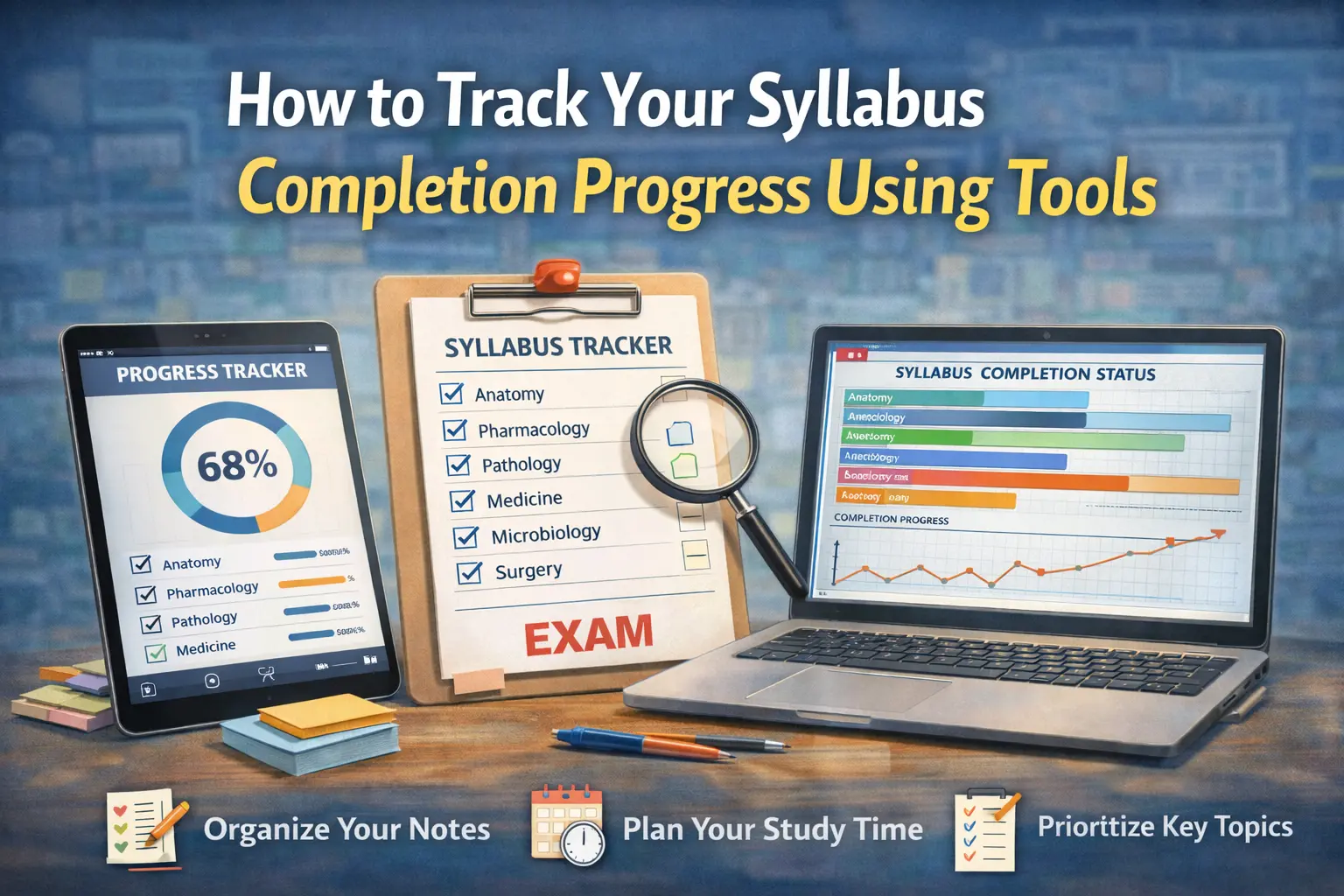
Digital planners are among the most effective tools for tracking syllabus completion. These tools allow students to plan their study schedule, mark completed chapters, and set daily study targets.
Most digital planners offer features such as:
Task management
Progress tracking
Study reminders
Performance analytics
By updating your progress daily, you can clearly see how much of the syllabus has been covered.
This organized approach significantly reduces stress and helps students aiming for medical colleges recognized by NMC, listed in WDOMS, and acknowledged by WHO stay focused on their preparation.
Using Spreadsheets for Syllabus Tracking
Spreadsheets are one of the simplest yet most powerful tools to track NEET syllabus completion.
Students can create a spreadsheet that includes:
Subject name
Chapter name
Completion status
Revision status
Test scores
Each chapter can be marked as:
Not started
In progress
Completed
Revised
Students can also add columns for mock test performance to identify chapters that need improvement.
After multiple tests, students can analyze their progress and estimate their rank using tools like a NEET Rank Predictor along with spreadsheet data.
Using Online NEET Preparation Platforms
Online learning platforms have become an essential part of NEET preparation. Many of these platforms provide built-in tools to track progress automatically.
These platforms usually provide:
Chapter-wise completion tracking
Test performance analytics
Weak topic identification
AI-based study recommendations
After each test, students receive detailed performance reports that highlight topics requiring further practice.
These tools help students cover the syllabus systematically and improve their chances of securing a higher rank according to the NEET Rank Predictor.
Leveraging Mock Tests and Performance Insights
Mock tests are one of the most effective ways to track both syllabus completion and exam readiness.
Each mock test provides insights into:
Strong topics
Weak topics
Time management issues
Accuracy levels
After attempting a mock test, students should analyze their mistakes and revise the relevant chapters.
Many platforms also allow students to estimate their expected rank through a NEET Rank Predictor.
Mock tests ensure that preparation aligns with the standards required to secure admission in medical colleges recognized by NMC and globally acknowledged directories like WDOMS and WHO.
Study Journals and Progress Logs
While digital tools are helpful, traditional study journals can also be extremely effective.
A study journal allows students to record:
Topics studied each day
Difficult concepts
Test scores
Revision schedules
Maintaining a daily record of progress encourages discipline and accountability.
It also ensures that students stay on track with the syllabus and improve their predicted rank using tools such as a NEET Rank Predictor.
Setting Weekly and Monthly Goals
Setting clear goals for syllabus completion is another important strategy.
Instead of focusing only on long-term preparation, divide your syllabus into weekly and monthly goals.
Example Study Plan
Week 1
Finish two chapters of Physics
Complete one chapter of Chemistry
Week 2
Complete one unit of Biology
Revise previously studied topics
Weekly evaluations help students adjust their preparation strategy and track improvement using tools like a NEET Rank Predictor.
Using Revision Tracking Tools
Studying a topic once is not enough for NEET success. Regular revision is essential for strong retention.
Revision tracking tools help students monitor how many times they have revised each chapter.
A strong revision strategy includes:
First revision within one week
Second revision within one month
Final revision before the exam
Tracking revision cycles ensures stronger conceptual clarity and improved performance in mock tests as well as in the NEET Rank Predictor.
Mistakes to Avoid When Tracking Syllabus Completion
While tracking progress is beneficial, students must avoid common mistakes.
Some common errors include:
Overcomplicating tracking systems
Ignoring weak topics
Skipping revision tracking
Focusing only on completion instead of understanding
Tracking progress should help build a strong conceptual foundation rather than simply completing chapters.
This preparation method also helps students secure admission in medical colleges approved by NMC and internationally recognized through directories such as WDOMS and WHO.
How Tracking Tools Improve Motivation
Maintaining motivation during long-term NEET preparation can be challenging.
Tracking tools provide visible evidence of progress, which helps students stay motivated and confident.
Seeing completed chapters and improved test scores encourages students to remain consistent in their preparation.
Similarly, improvements in predicted ranks through a NEET Rank Predictor can serve as a strong motivational factor.
How Analytics Can Help You Prepare Smart
Modern analytics tools allow students to analyze their preparation in detail.
These tools provide insights such as:
Accuracy percentage
Subject-wise performance
Time spent per question
Weak topic identification
Using such insights, students can adjust their study strategies and focus on weak areas.
Data-driven preparation gives students an advantage in competitive exams and improves their chances of securing admission in institutions approved by NMC and recognized by international directories such as WDOMS and WHO.
Conclusion
Tracking syllabus completion is one of the most crucial aspects of NEET preparation. Many students study for long hours but fail to monitor their progress regularly, which can lead to incomplete preparation.
By using tools such as digital planners, spreadsheets, online learning platforms, mock tests, and study journals, students can effectively track their syllabus coverage.
Regular performance analysis using analytics and tools like a NEET Rank Predictor helps students understand their strengths and weaknesses and improve their study strategy.
For students aspiring to enter medical colleges recognized by NMC and globally acknowledged directories like WDOMS and WHO, organized preparation and consistent progress tracking are essential.
With the right tools and a structured tracking system, completing the entire NEET syllabus becomes far more manageable—bringing you one step closer to achieving your dream of becoming a doctor. 🚀