The NEET Exam Pattern determines your preparation strategy
Understanding the NEET exam format is more than just knowing the format. It directly impacts how you prepare, revise and perform on the exam day. Many aspirants only focus on content, but those that align their preparation to the exam pattern gain an important advantage.
This guide will help you understand how the NEET exam's structure impacts your preparation strategy. You will also learn about the role of tools such as a NEET Rank Predictor and the importance of regulatory agencies like the National Medical Commission (NMC), World Directory of Medical Schools (WDOMS), or World Health Organization (WHO).
Exam Pattern for NEET
It is important to understand the exam structure before you can build a strategy.
Mode: Offline
Duration: 3 hours
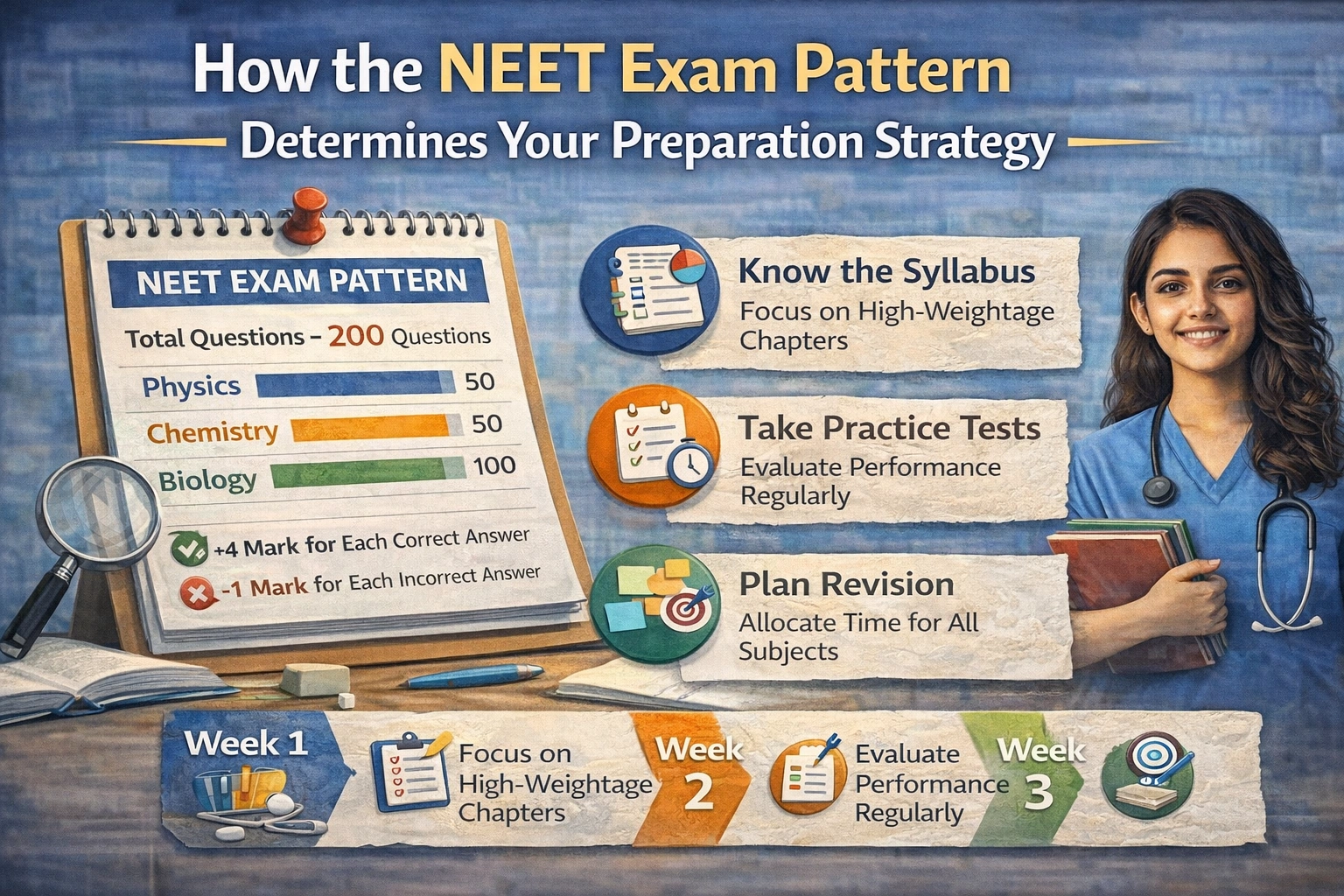
Subjects: Physics, Chemistry, Biology
Total questions: 200 (180 will be attempted).
Total Marks: 710
Marking Scheme
Each correct answer receives +4 marks
Each incorrect answer will receive a -1 mark
This structure explains how to approach preparation, time management and accuracy.
Why Exam Pattern Matters in Preparation
The NEET exam isn't just about knowledge, but about applying that knowledge within a set time frame. The pattern influences:
What to Study
How much practice is required?
How to manage your time
How to minimize negative marks
A well-aligned plan will ensure that you get the most out of your preparation.
Impact of NEET Exam Pattern on Preparation Strategy
1. The Study Focus is Determined by the Subject-Wise Weighing
Chemistry and Physics are followed by Biology in terms of weighting. This means:
Biology is important for scoring.
Maintain balance in Chemistry
Focus on Concept Clarity in Physics
Strategy
Biology: strong NCERT focus
Chemistry: a mix of theory and practice
Physics: Concept + numerical Practice
2. Objective Question Format Requires MCQ Practice
The NEET is entirely multiple-choice, so reading theory alone will not suffice.
Strategy
Practice 100-200 MCQs daily
Solve previous year's questions
Focus on accuracy and Speed
After mock tests, you can use a NEET Rank Predictor to evaluate your performance and adjust preparation.
3. Negative Marking Demands Accuracy
Blind guessing is dangerous because of the -1 mark for incorrect answers.
Strategy
Only confident questions should be attempted
Improve elimination techniques
Reduce silly mistakes
Accuracy is more important than answering all questions.
4. Time Constraint Shapes Practice Method
You have three hours to answer 180 questions. This requires speed and efficiency.
Strategy
Practice timed mock exams
Create a fixed order of attempts (Biology, Chemistry, Physics)
Improve question-solving speed
Your final score can be affected by your time management.
5. Sectional Division Helps Structured Preparation
The division of Physics, Chemistry and Biology allows for targeted preparation.
Strategy
Prepare each subject separately
Regularly take sectional tests
Identify and improve weak spots
A structured approach improves retention and performance.
6. NCERT-Based Questions Influence Study Material
NCERT is directly used in a large number of NEET questions. This is especially true for Biology and Chemistry.
Strategy
NCERT textbooks should be read thoroughly
Revise line-by-line
Focus on diagrams, key terms and terminology
Ignoring the NCERT can result in unnecessary loss of marks.
7. Mock Tests Become Essential
Due to the exam pattern, it is not optional to take mock tests.
Strategy
Weekly, complete full-length mock exams
Increase frequency nearer to the exam
Analyze mistakes in detail
The NEET Rank Predictor will help you track your expected ranking and measure improvements over time.
Role of NEET Rank Predictor in Strategy Building
The NEET Rank Predictor is a great tool to complement your preparation strategy.
Ranking based on scores
Setting realistic goals
Performance comparison over time
It is a feedback tool that helps you improve your approach.
Connection with NMC, WDOMS and WHO
Your preparation leads to medical school, which is governed and regulated by important institutions.
National Medical Commission
Ensures medical colleges in India adhere to standardized education systems, and admits students through NEET.
World Directory of Medical Schools
This directory provides a list of medical institutions around the world, which is important for students who are considering studying abroad.
World Health Organization (WHO)
Sets global standards for healthcare education and ensures the quality of medical training.
Understanding these organizations will help you align your career goals with your long-term preparation.
Common Mistakes Related to Exam Pattern
Ignoring negative marking
Do not practice enough MCQs
Skip mock tests
Poor time management
Over-reliance on sources other than NCERT
Avoiding these mistakes will improve your score.
Practical Preparation Plan Based on Exam Pattern
Daily Plan
Biology: 3-4 Hours
Chemistry: 2-3 Hours
Physics: 2-3 Hours
MCQs: 100-150 questions
Weekly Plan
1-2 full-length mock tests
Analysis of mistakes
Use of NEET Rank Predictor
Final Strategy for Exam Day
Attempt easier questions first
Spending too much time on a single question
Maintain accuracy
Stay calm and focused
You should prepare for the actual exam conditions.
Conclusion
The NEET exam structure is crucial in determining your preparation strategy. Your study plan should be aligned with the exam structure, from subject prioritization and time management to accuracy.
You can improve your performance by understanding the pattern and practicing consistently. You can also use tools such as a NEET Rank Predictor to help you. Keeping in mind the role of organizations such as the National Medical Commission and World Directory of Medical Schools will ensure that your efforts are aligned to your long-term career goals.
A smart strategy based upon the exam pattern could be the difference between a good score and a high ranking in NEET.