NEET 2017 Question Paper – Fill in the Blanks and Important Concepts
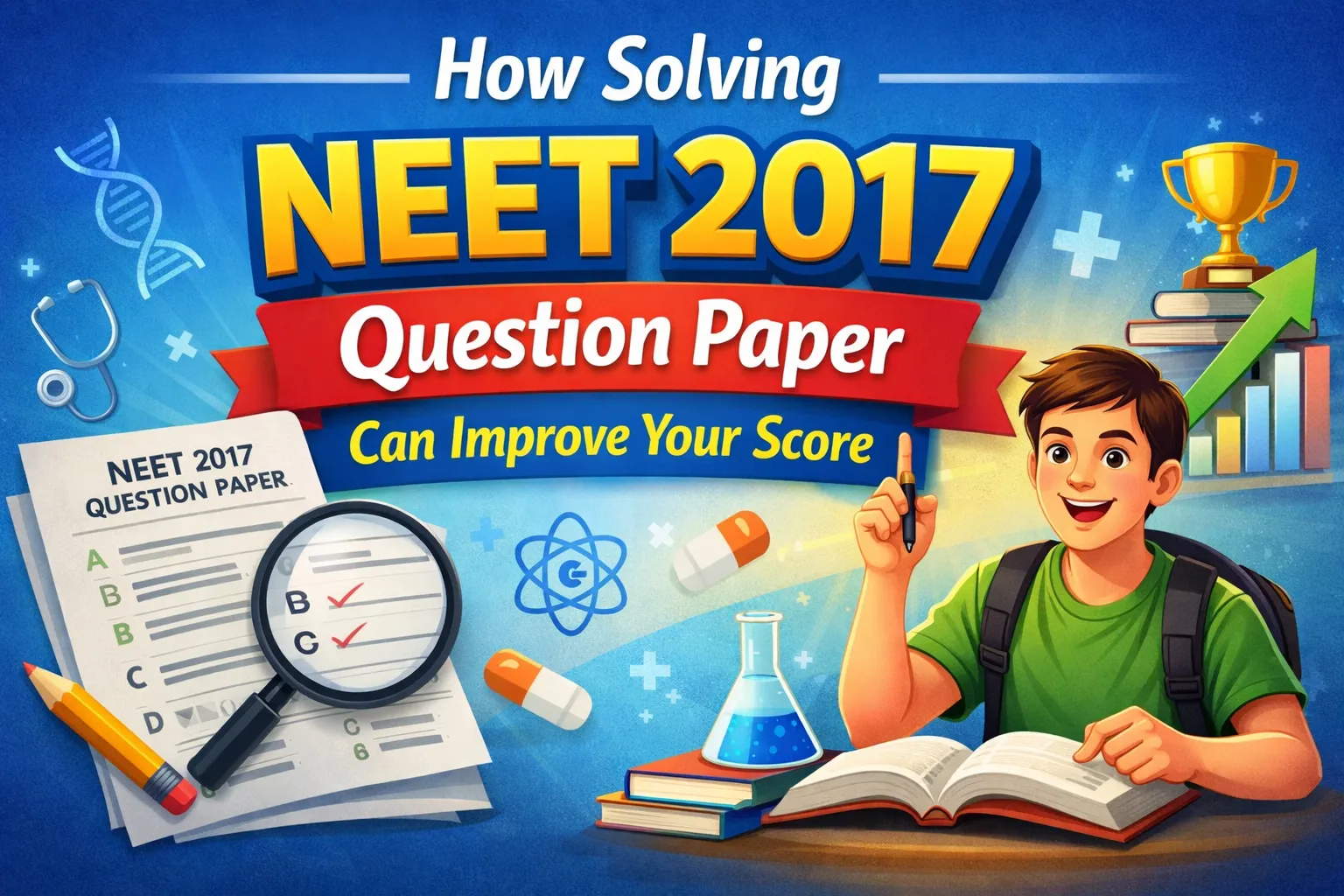
Preparing for the National Eligibility cum Entrance Test (NEET) requires strong conceptual understanding and consistent practice. One of the most effective preparation strategies is solving previous years’ question papers. Among them, the NEET 2017 question paper is a valuable resource because it helps students understand the type of questions, difficulty level, and important topics frequently asked in the exam.
Practicing such questions improves analytical skills and builds confidence for future exams like NEET 2026. Many aspirants also evaluate their performance after solving these papers using tools like the NEET Rank Predictor, which helps estimate their expected rank based on their score.
In this article, we will discuss some important fill-in-the-blank and conceptual questions from NEET 2017 from Physics, Chemistry, and Biology, along with explanations and preparation insights.
NEET 2017 Exam Pattern Overview
The NEET 2017 exam followed the standard medical entrance examination pattern used across India.
Exam structure
Physics: 45 questions
Chemistry: 45 questions
Biology: 90 questions
Marking scheme
Correct answer: +4 marks
Incorrect answer: −1 mark
The total exam carried 720 marks.
Solving the NEET 2017 paper along with other previous papers helps aspirants understand high-weightage topics and refine their exam strategy.
After solving the paper, students often calculate their score and estimate their expected rank using the NEET Rank Predictor tool.
Important Physics Questions from NEET 2017
Physics questions in NEET generally come from topics like mechanics, electricity, thermodynamics, optics, and modern physics.
Question 1: Work and Energy
Fill in the blank
The increase in potential energy when a 2 kg mass is lifted to a height of 5 m is ______.
Potential energy formula:
PE = mgh
Substituting the values:
m = 2 kg
g = 9.8 m/s²
h = 5 m
Answer:
98 Joules
This question tests the basic concept of gravitational potential energy.
Question 2: Ohm’s Law
Fill in the blank
A wire carries 3 A current when connected to a 12 V battery. The resistance of the wire is ______.
Using Ohm’s Law:
V = IR
Calculation:
12 = 3R
Answer:
4 ohms
Questions related to current electricity appear frequently in NEET.
Question 3: Photon Energy
Fill in the blank
The energy of a photon is given by ______.
Answer:
E = hν
Where:
h = Planck’s constant
ν = frequency
This concept belongs to modern physics, an important NEET topic.
Important Chemistry Questions from NEET 2017
Chemistry questions generally cover physical, organic, and inorganic chemistry.
Question 4: Chemical Bonding
Fill in the blank
A bond formed when two atoms share electrons is called a ______.
Answer:
Covalent bond
Chemical bonding is one of the most frequently asked topics in NEET Chemistry.
Question 5: pH Calculation
Fill in the blank
If the hydrogen ion concentration is 10⁻³, the pH of the solution is ______.
Formula:
pH = –log[H⁺]
Calculation:
pH = –log(10⁻³)
Answer:
3
Questions related to acids, bases, and pH calculations are common in NEET.
Question 6: Organic Chemistry
Fill in the blank
The functional group present in alcohol is ______.
Answer:
–OH (Hydroxyl group)
Organic chemistry often includes questions about functional groups and reactions.
Important Biology Questions from NEET 2017
Biology carries the highest weightage in NEET with 90 questions, making it the most scoring subject.
Question 7: Cell Biology
Fill in the blank
The organelle known as the powerhouse of the cell is ______.
Answer:
Mitochondria
Cell structure and function is a core topic in NEET Biology.
Question 8: Genetics
Fill in the blank
The father of genetics is ______.
Answer:
Gregor Mendel
Genetics and heredity are extremely important chapters in NEET Biology.
Question 9: Human Physiology
Fill in the blank
The component of blood responsible for transporting oxygen is ______.
Answer:
Hemoglobin present in red blood cells
Human physiology contributes a large number of questions in NEET exams.
High-Weightage Topics from NEET 2017
Analyzing the NEET 2017 question paper helps identify important topics.
Physics
Laws of motion
Work, energy, and power
Current electricity
Optics
Modern physics
Chemistry
Chemical bonding
Organic functional groups
Thermodynamics
Electrochemistry
Coordination compounds
Biology
Cell structure and function
Human physiology
Genetics and evolution
Ecology and environment
Plant physiology
Students focusing on these chapters usually achieve higher scores.
Many aspirants also analyze their expected rank after solving these topics using the NEET Rank Predictor.
Benefits of Solving Previous NEET Question Papers
Practicing previous papers like NEET 2017 provides several advantages.
Understanding Exam Trends
Students learn about frequently asked topics and exam patterns.
Improving Problem-Solving Skills
Numerical and conceptual questions improve analytical thinking.
Strengthening Concepts
Detailed solution analysis helps clarify complex concepts.
Evaluating Performance
Students can calculate their scores and predict their expected rank using the NEET Rank Predictor.
Importance of Recognized Medical Universities
After qualifying NEET, students must choose medical colleges carefully.
Medical universities should be recognized by major authorities such as:
National Medical Commission (NMC)
World Health Organization (WHO)
World Directory of Medical Schools (WDOMS)
Recognition ensures that graduates can appear for medical licensing exams worldwide.
How to Use Previous Year Papers Effectively
To benefit fully from the NEET 2017 question paper, students should follow this strategy:
Solve the paper in exam-like conditions
Check answers using the official answer key
Analyze mistakes carefully
Revise weak topics thoroughly
Practice additional questions from those chapters
Tracking progress with tools like the NEET Rank Predictor can help students monitor their preparation level.
Conclusion
Solving previous year's NEET papers, like NEET 2017, is one of the most effective preparation strategies. These papers provide insight into the exam pattern, question difficulty, and high-weightage topics.
Regular practice of past papers helps students strengthen their conceptual understanding, improve speed, and build exam confidence.
Along with consistent practice and revision, aspirants should also evaluate their performance using tools like the NEET Rank Predictor and ensure that their chosen medical colleges are recognized by authorities such as the National Medical Commission, World Health Organization, and World Directory of Medical Schools.
With the right preparation strategy and continuous practice, students can significantly improve their chances of cracking NEET and securing admission to their desired medical college. 🚀