Exam Date Comparison from 2016 to 2017 - NEET Historical Data
NEET is an important examinations for all aspiring medical students in India as it marks one biggest entrance examination. Every year, hundreds of thousands of students take the exam with an aim to get admission to MBBS and BDS courses. NEET exam date details — In-depth overview NEET historical dates of INDIAN medical entrance exams.
The details of such NEET exam dates of the previous 2 years will help aspirants understand how the pattern and schedule have been changing through recent years. Students can also use this analysis to manage their preparation strategy well.
Today, most aspirants also check their probable performances through an NEET Rank Predictor that gives them an estimated rank based on the score they would get.
In this article, we will compare the NEET exam dates of 2016 and 2017, look into major differences in timelines as well as discuss what these trends signify for NEET aspirants.
NEET 2016 and NEET 2017 Summary
It is essential to know about these two examinations before actually comparing the exam dates.
The following NEET 2016 exam was a year of transformation for medical entrance system in India. NEET, on the other hand, supplanted a number of other state-level and private medical entrance exams in this time period.
NEET 2017 was the first year when the exam was conducted as a comprehensive, nationally common examination for admissions into medical institutions.
Both the exams consist of 180 multiple-choice questions from Physics, Chemistry and Biology.
Students tend to use a NEET Rank Predictor after taking mock tests based on these exams, so they can gauge what their estimated rank would be.
NEET 2016 Exam Timeline
(2016 NEET exam was in two phases that year, so the structure is a bit different)
Important Dates of NEET 2016
| Event | Date |
|---|---|
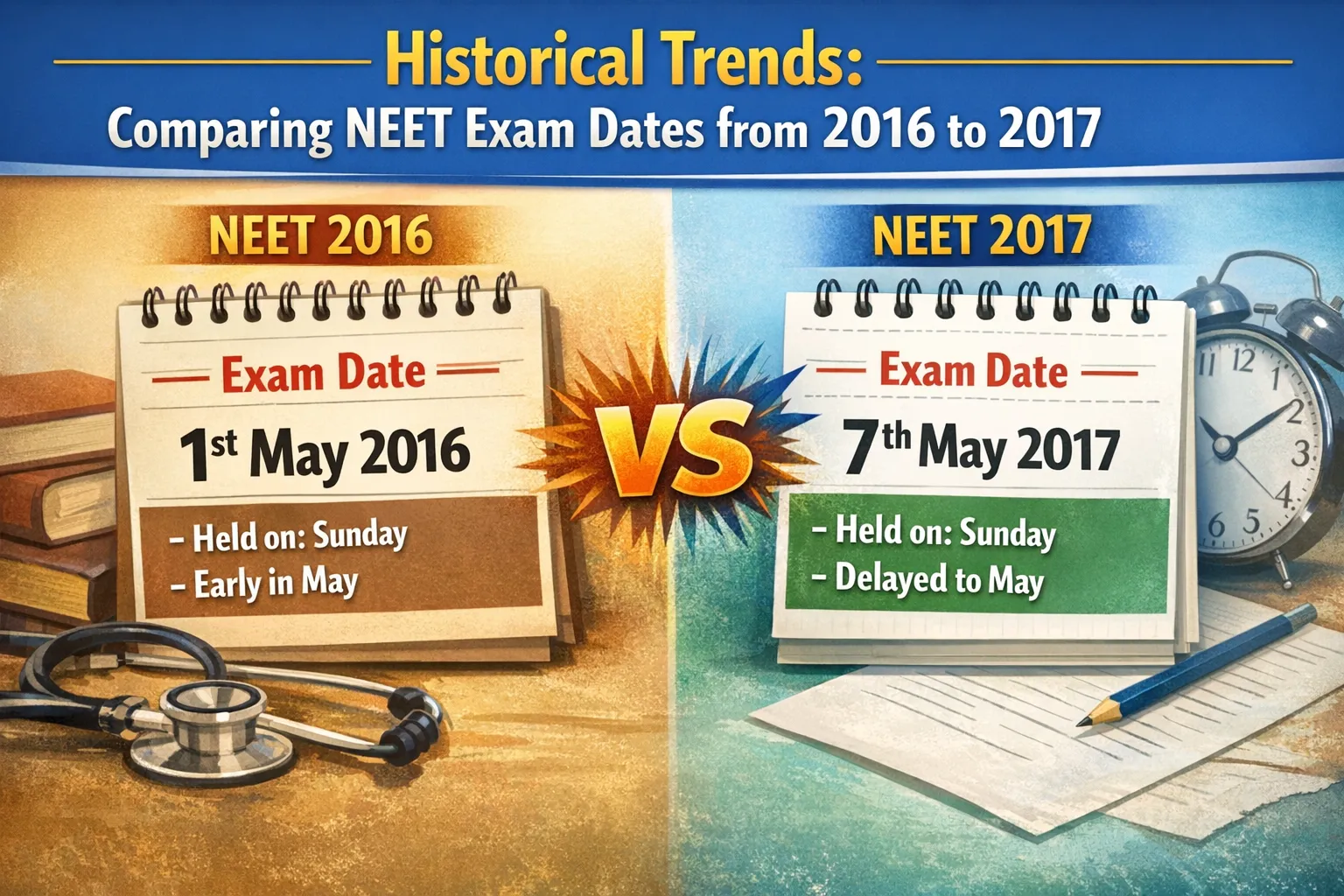
| NEET Phase 1 (AIPMT) Exam Date | May 1, 2016 |
| NEET Phase 2 Exam Date | July 24, 2016 |
| Date of Result Declaration | August 2016 |
| Counseling Process Date | September 2016 |
For instance, NEET 2016 had permitted candidates who appeared for other exams to take the second phase.
The two-phase system was implemented to allow for gradually adapting to the new exam structure at the national level.
NEET 2017 Exam Timeline
The NEET 2017 exam had a more washed schedule with respect to that of the year 2016.
Important Dates of NEET 2017
| Date | Event |
|---|---|
| January 31, 2017 | Application Form Release |
| March 1, 2017 | Last Date for Application |
| April 2017 | Admit Card Release |
| May 7, 2017 | NEET 2017 Exam Date |
| June 23, 2017 | Result Declaration |
| July 2017 | Counseling Process |
This timeline served as the basis for the NEET schedules that followed in subsequent years.
Many students calculated the scores few even analysed using NEET Rank Predictor once the results were declared.
Difference Between NEET 2016 and NEET 2017
Content : These two years are compared to show key differences in the exam structure or schedule.
Single Phase vs Two Phases
Perhaps the biggest difference was the number of phases to your test.
NEET 2016: Held in two phases
NEET 2017: Held in a single phase
This made the admission process simpler and scrupulously unbiased.
Standardized National Examination
NEET 2017 was the first-ever fully standardized national-level medical entrance exam.
From 2017, NEET became the only entrance test for MBBS and BDS admissions in India.
More Structured Preparation Timeline
In 2017, NEET was held during a time when students had more organized preparation time.
The gap between January and May was sufficient for aspirants, to:
Final revision
Mock tests
Solving previous years’ papers
Many students used the NEET Rank Predictor, after taking their mock tests, to analyse their performance.
Effects of These Changes on Students
What is the difference between NEET 2016 to NEET 2017 and how did it affect students?
Reduced Confusion
The one-step examination system eliminated confusion and made things easier for aspirants when it comes to admissions.
Increased Competition
The number of candidates shot up after NEET was established as the sole medical entrance exam.
It resulted in increased competition and subsequently higher cut off marks.
A majority of the students began availing themselves assistance from tools such as a NEET Rank Predictor, which helps them identify their position with respect to other aspirants.
Better Preparation Strategy
The common timeline helps students and the coaching institute to streamline their preparation.
Mock tests and practice papers acquired greater significance in NEET preparation.
A scientific study on the role of NMC, WHO and WDOMS in medical education
Once students have successfully cleared NEET and taken admission in a medical college, its their responsibility to make sure that the college is recognized by relevant authorities.
NMC (National Medical Commission)
The NMC also monitors the academic standard of medical colleges and ensures that the medical education provided by these institutions retains the right quality in India.
NMC recognized graduated are entitled to practice in India.
WHO (World Health Organization)
The WHO is concerned with universal improvement of healthcare systems and the international accreditation of medical establishments.
All medical universities that fall under WHO are widely acknowledged as credible for any of the medical education programs.
WDOMS (World Directory of Medical Schools)
The WDOMS offers a global listing of recognized medical schools.
Medical universities that are included in WDOMS, their degree is acceptable all over the world.
Students wishing to pursue medicine abroad must confirm that their university is valid for NMC, WHO and also mentioned in WDOMS.
How pupils may Historical Dynamics for Preparation
Historical exam trends analysis can help the students in their preparation for NEET.
Plan Preparation Early
Being aware of exam deadlines allows students to begin preparation earlier.
Focus on Revision
Most successful aspirants focus on revision and practice the last months before the exam.
Solve Previous Years’ Papers
Solving previous years NEET question papers helps in knowing the pattern of questions and also aids to increase speed.
Track Performance
After solving mock tests, students can assess their expected rank using a NEET Rank Predictor.
Conclusion
NEET 2016 vs NEET 2017, the timeline for comparison between the two medical entrance examination dates reveals a crucial transition of medical entrance exam population in India NEET 2016 was held in two stages as part of a transitional phase, whereas NEET 2017 brought a streamlined single-phase exam structure.
This step made it easier to get into medical school, stirred competition among schools and helped pave the way for a common entrance procedures across the nation.
Solving past years papers and regularly using the NEET Rank Predictor can help students forecast their performance and make necessary adjustments to improve.
Also, the aspirants must also check if their preferred medical colleges are recognized by WDOMS and WHO with run organization NMC after passing the exam.
NEET aspirants can greatly enhance their likelihood of success in this fiercely competitive exam by devising an effective preparation strategy and rightly discerning the trends in the questions. 🚀