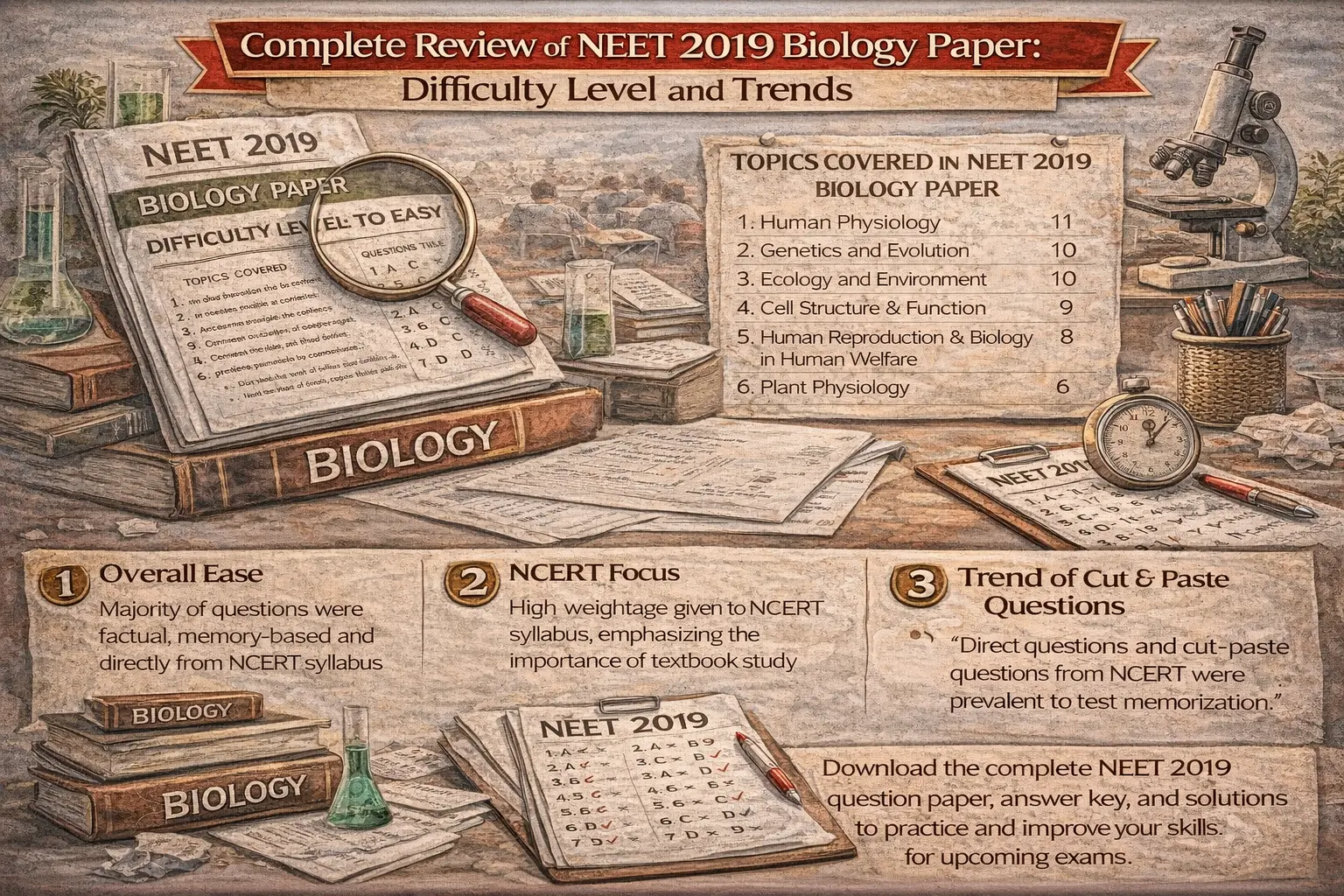
NEET 2019 Biology Paper Full Analysis — Types and Difficulty Level
The most significant entrance exam for students preparing to pursue MBBS and other medical courses at the Indian level is the National Eligibility cum Entrance Test (NEET). Biology, accounting for the highest weightage in the exam, is probably the most important subject from this perspective.
For NEET, Biology is divided between Botany and Zoology together carrying 90 questions out of 180, or 360 marks out of the total 720 marks. Due to this heavy weightage, a good performance in Biology can elevate the overall score of students considerably.
By analyzing the NEET 2019 Biology paper, aspirants can get a good idea about the difficulty level, important topics and trends of the exam. Students often analyze their performance using tools such as the NEET Rank Predictor to estimate their expected rank and possible medical colleges.
Given the intense competition for medical seats in India, many students also explore options to study medicine abroad such as mbbs in georgia where universities offer globally recognized medical degrees. These institutions are recognized by organizations like the World Health Organization, listed in the World Directory of Medical Schools and approved by the National Medical Commission.
NEET 2019 Biology Section Overview
The NEET 2019 Biology paper contained 90 questions that were distributed equally between Botany and Zoology.
Section | Number of Questions | Marks
Botany | 45 | 180
Zoology | 45 | 180
Total Biology Questions | 90 | 360
4 marks were awarded for each correct answer.
1 mark was deducted for every wrong answer due to negative marking.
A strong performance in this section significantly increases the probability of achieving a high rank because Biology accounts for 50% of the total marks.
NEET 2019 Biology Paper Difficulty Level
According to most experts and coaching institutes, the NEET 2019 Biology paper was moderate in difficulty.
Several characteristics defined the paper:
Most questions were directly based on NCERT textbooks
Some questions required conceptual understanding rather than memorization
A few questions were statement-based or application-oriented
Students who thoroughly studied NCERT Biology textbooks were able to answer the majority of questions confidently.
Botany Section Analysis
The Botany section was of moderate difficulty and included questions from both Class XI and Class XII NCERT syllabus.
Important Botany Topics
Plant Physiology
Plant physiology formed a significant part of the Botany section.
Key topics included:
Photosynthesis in higher plants
Respiration in plants
Plant growth and development
Mineral nutrition
These topics require a strong understanding of plant metabolic processes.
Plant Diversity
Questions related to plant diversity included topics such as:
Algae
Bryophytes
Pteridophytes
Gymnosperms
These questions were relatively easy for students who memorized classification features.
Plant Anatomy
Plant anatomy questions included topics such as:
Tissue systems
Secondary growth
Internal plant structures
These questions often tested conceptual knowledge and diagram interpretation.
Zoology Section Analysis
The Zoology section was also moderately difficult, with several questions based on fundamental biological concepts.
Important Zoology Topics
Human Physiology
Human physiology is one of the most important topics in NEET Biology.
In the NEET 2019 paper, questions were asked from:
Digestion and absorption
Respiration in humans
Neural control and coordination
Circulatory system
Students who revised these chapters thoroughly performed well.
Genetics and Molecular Biology
Genetics is another high-weightage topic in NEET.
Key areas included:
Mendelian genetics
DNA replication
Genetic disorders
Gene expression
These topics require both conceptual clarity and problem-solving skills.
Evolution
Questions from evolution focused on:
Evidence for evolution
Natural selection
Human evolution
These questions were mainly NCERT theory-based and conceptual.
Chapter-Wise Weightage Trends
Chapter-wise question distribution analysis helps students identify important chapters.
Some chapters that had higher weightage in NEET 2019 included:
Human Physiology
Genetics and Evolution
Ecology and Environment
Cell Biology
Plant Physiology
These chapters should be prioritized during NEET preparation.
Importance of NCERT in NEET Biology
One of the key observations from the NEET 2019 Biology paper was the strong reliance on NCERT textbooks.
Many questions were:
Directly taken from NCERT statements
Adapted from NCERT examples
Based on NCERT diagrams and concepts
Because of this trend, students preparing for NEET should focus heavily on NCERT Biology textbooks.
Types of Questions Asked in NEET 2019 Biology
Several types of questions appeared in the Biology section.
Direct Concept Questions
These questions tested basic theoretical knowledge.
Statement-Based Questions
Students were given statements related to biological concepts and asked to determine whether they were correct.
Diagram-Based Questions
Some questions involved interpreting diagrams related to:
Plant anatomy
Cell structures
Biological processes
Biology Marks and NEET Ranking System
Biology plays a crucial role in determining the final NEET rank because it contributes 360 marks out of 720.
Students who score 320+ marks in Biology often significantly improve their rank in the merit list.
After estimating their score, candidates commonly use tools like the NEET Rank Predictor to estimate their expected rank and evaluate admission possibilities.
Effect of NEET Competition on Students
Because of the limited number of medical college seats in India, many students who qualify NEET still fail to secure an MBBS seat.
This intense competition has encouraged some students to explore international medical education opportunities.
A popular destination for Indian students is mbbs in georgia where universities provide:
Affordable tuition fees
English-medium medical education
Globally recognized medical degrees
Many universities offering mbbs in georgia are recognized by the World Health Organization, listed in the World Directory of Medical Schools and approved by the National Medical Commission.
After graduation, students can appear for licensing examinations to practice medicine in different countries.
Important Preparation Tips from NEET 2019 Biology Analysis
The NEET 2019 Biology paper provides useful insights for future aspirants.
Focus on NCERT
NCERT textbooks remain the core study material for Biology.
Practice Previous Papers
Solving previous year papers helps students understand the exam pattern and types of questions.
Revise Important Chapters
Priority should be given to topics like:
Genetics
Ecology
Human physiology
Avoid Guesswork
Random guessing can reduce scores because of negative marking.
Conclusion
The NEET 2019 Biology paper analysis shows that this section played a critical role in determining overall scores, as it included 90 questions from Botany and Zoology.
Important topics such as human physiology, genetics, plant physiology and ecology contributed significantly to the paper.
Students preparing for NEET should analyze previous year papers, strengthen conceptual understanding and thoroughly revise NCERT Biology textbooks.
After calculating their expected score, candidates can also use tools such as the NEET Rank Predictor to estimate their probable rank and plan their admission strategy.
For students unable to secure a medical seat in India due to intense competition, international education options like mbbs in georgia provide opportunities through universities recognized by the World Health Organization, the World Directory of Medical Schools and the National Medical Commission.
Ultimately, consistent practice, conceptual clarity and strategic preparation remain the keys to success in the NEET examination.