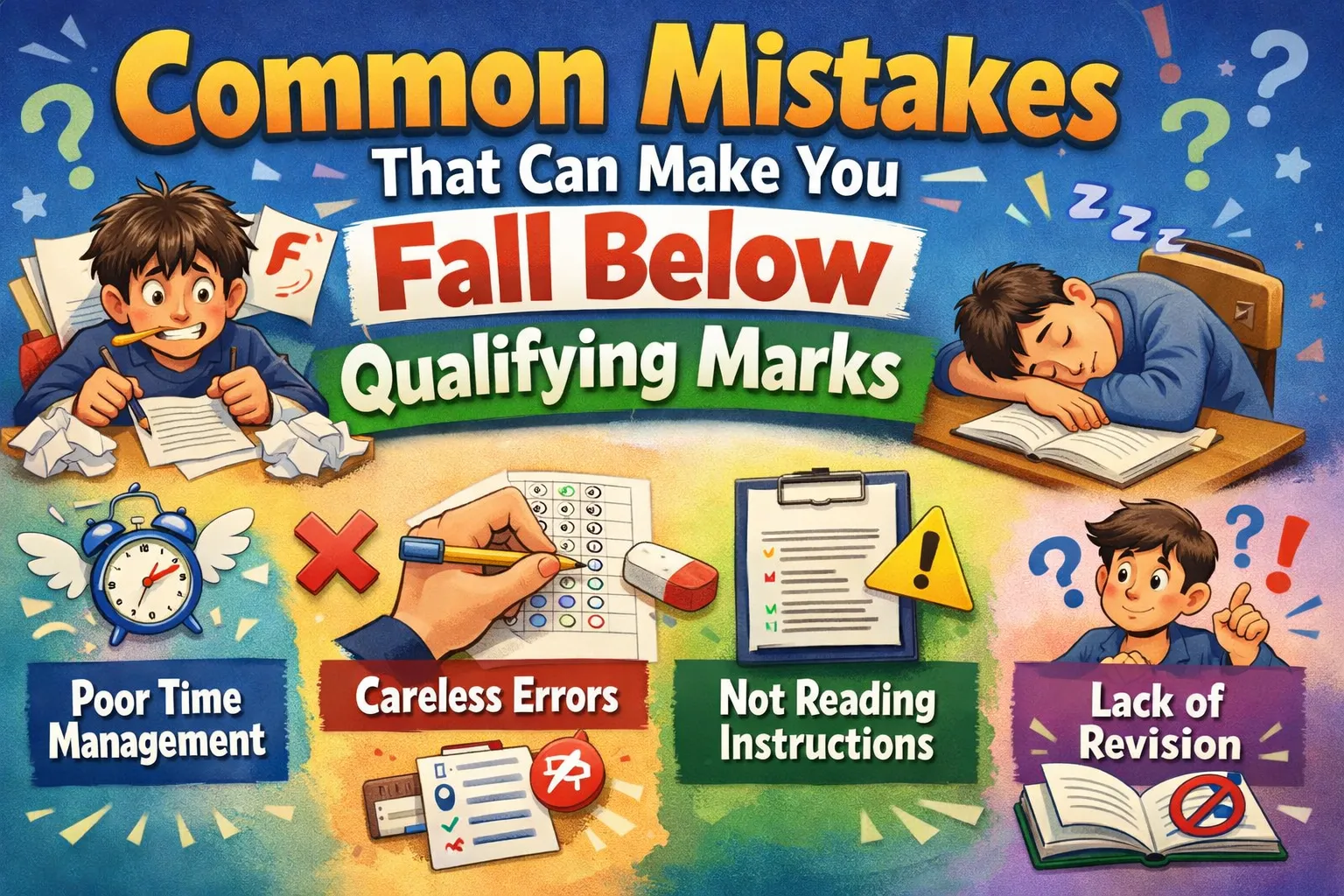
Mistakes That Can Result in Falling Below Qualifying Marks
It is more about studying smart and not making the same mistakes as thousands of aspirants do every year, unknowingly. Many students who can score well actually fall short of the qualifying marks due to a poor strategy, unawareness or mistakes on exam day. So, knowing these mistakes can help in passing that fine line lies between a success and failure.
Through this post, we will focus on the common mistakes which can keep you below qualifying marks and NEET Rank Predictor as well as NMC, WDOMS and WHO Guidelines that support you to stay in line.
Lack of Conceptual Clarity
Aspirants often try focusing on rote learning and ignore concepts, which is probably the biggest mistake! NEET, in particular, is meant for testing your conceptual knowledge of different subjects especially Physics and Chemistry.
Students tend to rote learn the formulas but are not able to relate it in reuse. This creates confusion in case the questions are twisted or concept based.
Solution:
Focus on NCERT fundamentals
Practice concept-based questions
Revise regularly
After attempting mock tests, using a NEET Rank Predictor allows you to analyze your conceptual clarity and if the same is enough to get qualifying marks.
Ignoring NCERT Books
Students depend on reference books and coaching material and overlook NCERT. But a good majority of NEET questions, especially Biology ones is directly from NCERT.
Neglecting NCERT yourself could even lead you nowhere near the qualifying marks.
Solution:
Read NCERT multiple times
Highlight key points
Practice NCERT-based MCQs
Don't forget that even agencies like NMC are not undermining the need for a good academic background, starting with NCERT-based concepts.
Poor Time Management
Poor time management while preparing and during the exam can be a recipe for disaster. They either take more time in just one subject or they fail to complete the paper on time.
Common issues include:
Fumbling with hard questions for too long
Not allocating time per section
Lack of timed practice
Solution:
Follow a structured timetable
Practice full-length mock tests
Analyze time spent per question
As a result, you can use a NEET Rank Predictor after every timed test which provides you with an estimate of your performance and also indicates what should be done to avoid the time management crisis.
Skipping Mock Tests
Most aspirants refrain from mock tests because they are scared of getting low marks. This is a critical mistake. Mock tests give you experience of real exam environment and prepares your mind for it.
Without mock tests, you:
Lack exam temperament
Fail to identify weak areas
Misjudge your preparation level
Solution:
Attempt weekly full-length tests
Analyze mistakes thoroughly
Use NEET Rank Predictor tools to keep track of progress
Not Analyzing Mistakes
Testing alone is not enough — it’s analysis that really flips the script. Students often test multiple times but don’t study their mistakes.
This ends up getting us to repeat the same errors in actual exam.
Solution:
Maintain an error notebook
Review incorrect answers
Find out the reason for your mistake
Therefore, it is important that you analyze regularly so that your accuracy increases and you are always above the qualifying marks.
Overconfidence or Underconfidence
Both extremes are potentially harmful to your performance.
Overconfidence:
Skipping revision
Ignoring weak areas
Underconfidence:
Doubting correct answers
Changing answers unnecessarily
Solution:
Maintain a balanced mindset
Trust your preparation
Practice mindfulness during exams
Poor Revision Strategy
Most students over-study but do not revise actively. Without revision, retention decreases significantly.
Solution:
Adhere to a revision cycle (weekend + monthly)
Use short notes and flashcards
Revise high-weightage topics frequently
The best scorers themselves depend on revision to keep performances consistent.
Ignoring Exam Pattern and Syllabus
The exam NEET has a defined syllabus and pattern. Misunderstanding that can cause you to waste your efforts on things that don't matter.
Solution:
Stick to the official syllabus
Focus on high-weightage chapters
Practice previous year questions
The curriculum is aligned with standards of international organizations such as WHO and academic frameworks reported in WDOMS to ensure standardized assessment processes.
Negative Marking Mismanagement
NEET follows a negative marking scheme and with guess work many students lose marks.
Common mistakes:
Attempting too many doubtful questions
Not eliminating wrong options
Solution:
Attempt only confident questions
Use elimination techniques
Practice accuracy over attempts
A NEET Rank Predictor Can Display the Effect of Negative Marking on Your Overall Ranking and Fine-Tune Your Strategy
Lack of Awareness Of Eligibility And Directives
The criteria after completing the exam such as recognition by colleges, documentation is often ignored.
Understanding organizations like:
NMC (National Medical Commission) – Oversees medical education in India
UPDATE #1: GUIDE RESOURCES WDOMS (World Directory of Medical Schools) – lists globally recognized medical institutions
Until this training is complete, the exercise relies on data up to October 2023.
Knowing it is important, especially for those who wish to pursue MBBS in India or abroad.
Exam Day Mistakes
Even well-prepared students can fall short with simple errors on the exam day:
Not reading questions carefully
Filling OMR incorrectly
Panic and anxiety
Poor time allocation
Solution:
Stay calm and focused
Double-check OMR entries
Attempt easy questions first
Lack of Consistency
WE WILL BE CONSISTENT IN NEET PREPARATION. Most students begin well, but tire out as time goes by.
Solution:
Set daily goals
Track progress
Stay disciplined
A regular use of a NEET Rank Predictor can help to boost your motivation by showing trends that reflect improvement.
Not Using Performance Analysis Tools
In this digital era, one should never miss out on such beneficial tools like NEET Rank Predictor. These tools provide insights into:
Expected rank
College prediction
Performance comparison
They allow you to reset your strategy before it’s too late.
Conclusion
Most students who fail to qualify in NEET fall under the intelligent category but lose marks due to avoidable mistakes. It can make or break your performance from poor time management, not going through the NCERT and skipping mock tests.
By being aware of the updates, practicing them while leveraging tools such as NEET Rank Predictor will help you to keep track and always prepare ahead. Plus, knowing what organizations like NMC, WDOMS and WHO do helps you in ensuring that your preparation is always in line with the national as well global medical education policies.
With these common mistakes set aside and keeping your focus on the target, you will tremendously boost your chances of getting above qualifying score in NEET and grab your seat to a reputed medical college. 🚀