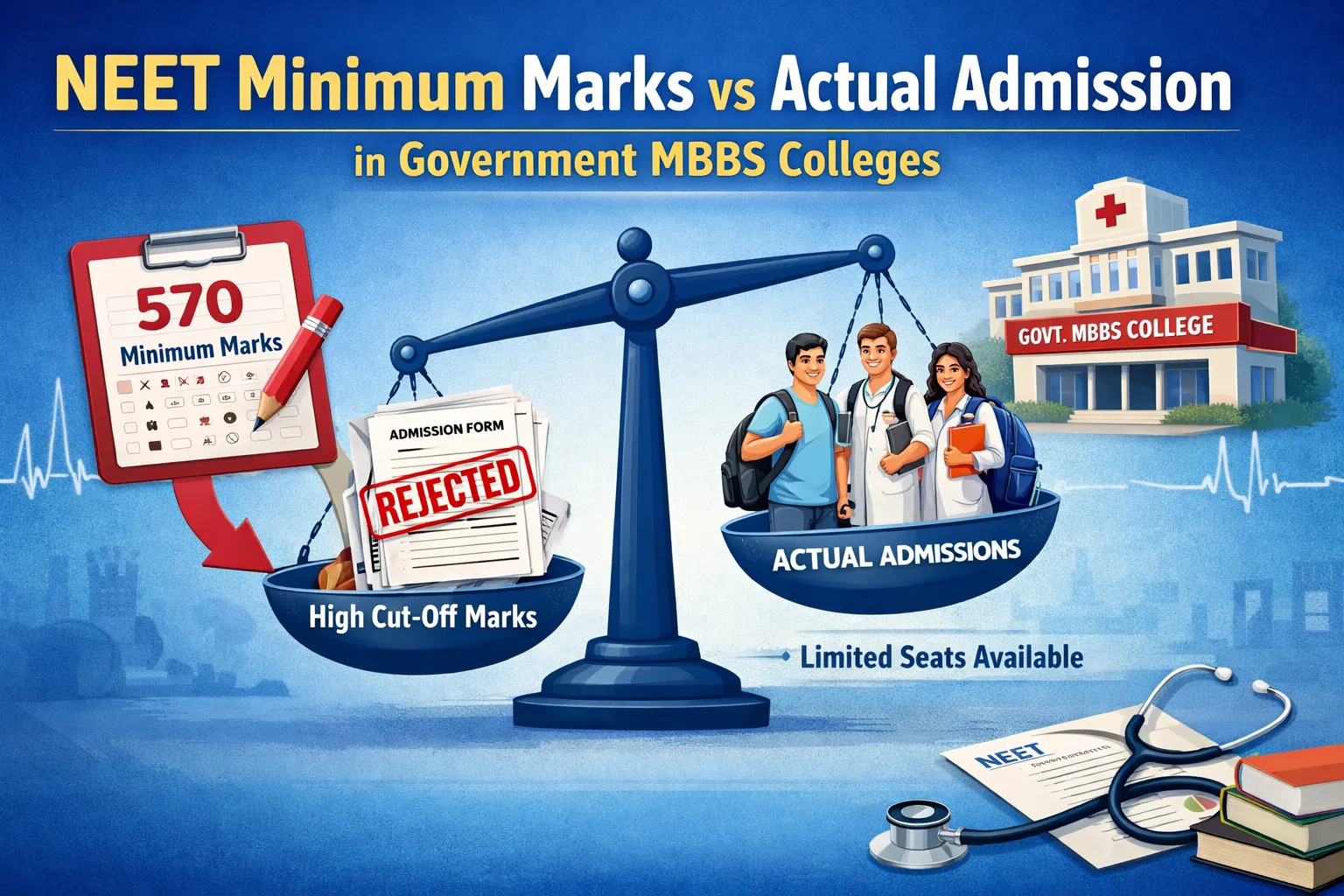
Minimum NEET Marks vs Actual Admission in Government MBBS Colleges
Every aspirant for NEET once in their life thought “Minimum marks kitne chahiye MBBS ke liye?” This leads to confusion as the minimum or qualifying marks are entirely different than the admission marks. So students clear NEET also but still are not able to get a government seat in MBBS just because their rank is not in the race.
This guide will explain the difference between minimum marks seen on various documents and actual admission standards; why this gap exists; and therefore how utilities like the NEET Rank Predictor—on top of directives from the National Medical Commission as well as global rating bodies like the World Directory of Medical Schools or even the World Health Organization—contribute to a winning medical career choice.
What Are NEET Minimum (Qualifying) Marks?
NEET Qualifying Marks – The minimum marks to qualify for NEET, which is necessary for counselling
Qualifying Percentile:
General: 50th percentile
OBC/SC/ST: 40th percentile
General-PwD: 45th percentile
Approx Qualifying Marks:
General: 130–160 marks
OBC/SC/ST: 110–140 marks
👉 Important:
These marks only entitle you to appear in counselling. They do not guarantee admission.
⚠️ What Does Actual Admission Marks Mean?
Actual admission marks are pre-requisites to obtain a seat in government MBBS college.
Typical Admission Range:
General category: 600–680+ marks
OBC: 580–650 marks
SC/ST: 500–600 marks
👉 This is clearly a huge difference between qualifying and admission marks.
Minimum Marks vs Admission Marks (Analysis)
Purpose
Minimum Marks → Qualification
Admission Marks → Seat allotment
Marks Range
Minimum Marks → ~130–160
Admission Marks → 500–680+
Competition Level
Minimum Marks → Low
Admission Marks → Extremely High
Guaranteed MBBS?
Minimum Marks → ❌ No
Admission Marks → ✔ Possible
👉 Conclusion:
Passing NEET is only a beginning — for admission, much superior performance is needed.
📈 Why This Huge Gap Exists
Limited Government MBBS Seats
Over 20 lakh NEET aspirants
Around ~1 lakh MBBS seats
👉 Result: Intense competition
Large Number of Qualified Students
Percentile-based cut-off allows many students to qualify
Seats are reserved only for top-ranking candidates
Rank-Based Admission System
Counselling for NEET is held on the basis of ranking and not marks.
Example:
150 marks → Rank in lakhs
600 marks → Top 30,000 rank
👉 Two students could each qualify, but only one gets admitted.
📉 Marks V/S Rank: The Actual Game
It’s not marks that determine your future; it is rank.
Approx Trend:
650+ marks → Top 10,000 rank
600 marks → ~20,000–30,000 rank
500 marks → ~80,000+ rank
Now do you see why a NEET Rank Predictor is so important? It helps you:
Estimate your expected rank
Understand admission chances
Plan your strategy realistically
🏥 Government MBBS Cut-Off Reality
The high demand of all government colleges is because of:
Low fees
High-quality education
Recognized by National Medical Commission
Real Insight:
Top colleges: 650+ marks
Mid-level govt colleges: 600+ marks
Government colleges (some states): 550+ marks
👉 Chances are extremely slim if below this range.
🌍 Role of WDOMS and WHO
Even as the focus is on Indian colleges, it’s important to keep global standards in mind too.
World Directory of Medical Schools ensures your medical college is globally recognised
World Health Organization sets global healthcare education standards
👉 This is essential if you plan to study or practice abroad in the future.
❌ Common Misconceptions
Myth 1: “140 is MBBS cutoff for me”
✔ Reality: Sirf qualify theek hai
Myth 2: “Competition easy hai, kyuki cut-off low hai”
✔ Reality: Admission ka cut-off bahut high hota hai
Myth 3: “It is easy for reserved category students”
✔ Reality: Sabhi category me competition intense hai
📉 What if you get a low score?
130–200 Marks
Only qualification
No MBBS chance
200–400 Marks
Limited options
Private colleges/BDS
400–550 Marks
Borderline cases
Mostly private colleges
👉 Government MBBS ke liye:
550+ minimum target hona chahiye
✨ MBBS FOR GOVERNMENT SMART STRATEGY
Aim High, Not Minimum
👉 Target: 600+ marks
Focus on High-Weightage Topics
Biology NCERT
Organic Chemistry
Modern Physics
Practice Mock Tests
Improve speed
Reduce mistakes
Use NEET Rank Predictor
Track progress
Set realistic goals
Analyze Performance
Identify weak areas
Improve accuracy
📊 MARKS VS CHANCES (GOVT. MBBS)
130–200 → Only enter
200–400 → No MBBS
400–550 → Very low
550–600 → Possible (limited cases)
600–650 → Good chances
650+ → Top colleges
🏁 Final Conclusion
A closer look at NEET aspirants will tell you the biggest lesson:
👉 Competition is the only thing that matters, even minimum marks are not enough
Qualifying marks → Easy to achieve
Admission marks → Require serious preparation
If you are aiming for a government MBBS seat:
Don’t aim for 150 marks
Aim for 600+ marks
Follow NEET Rank Predictor, National Medical Commission guidelines, and stay updated with global benchmarks like World Directory of Medical Schools and World Health Organization.
👉 Final truth:
“In NEET, qualifying gets you in the race — but high marks decide who wins.” 🚀