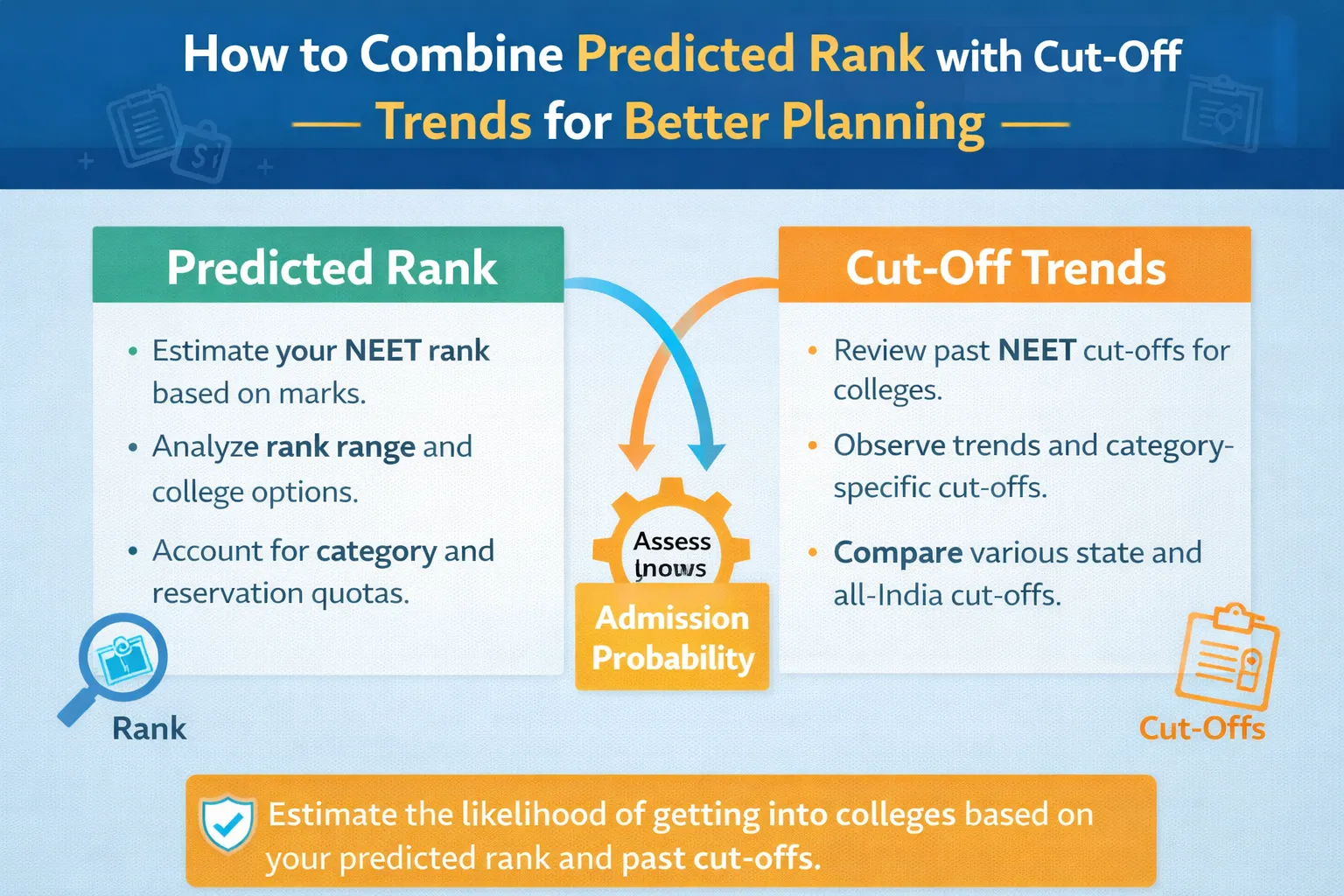
How to Use Predicted Rank Along With Cut-Off Trends for Better Planning
Determining your NEET counselling strategy is not only dependent upon the score that you expect. The most intelligent aspirants analyze their predicted rank using previous years cut-off trends and make the right and practical decision. It brings more clarity and enhances the possibilities to fill up good medical seat.
In this comprehensive guide, discover how to effectively use a NEET Rank Predictor with cut-off analysis and what role the National Medical Commission (NMC), World Directory of Medical Schools (WDOMS), and World Health Organization (WHO) will have on your final decision.
NEET and Predicted Rank
NEET, also known as the National Eligibility cum Entrance Test, is a competitive exam conducted for aspiring medical students in India.
Predicted rank or the predicted All India Rank (AIR) based on your probable NEET score. A NEET Rank Predictor analyses last year''s data, difficulty and trends in performance of candidates to come up with a rank range.
For example:
Score: 620 marks
Predicted Rank: 8,000 – 12,000
Then you have a range as your starting point for planning.
What Are Cut-Off Trends?
Cut-off trends is basically the minimum marks/rank required to be admitted into a particular college in recent years.
These cutoffs vary based on:
Category (General, OBC, SC, ST)
Quota (AIQ, State)
College type (Government, Private)
Understanding these trends aids you with realistic admission expectations.
The Importance of Combining cut-off and Rank
Practicing this approach never leads to a good end.
Seat allotment not based on just predicted rank
Shifts in Cut-off are not the only thing indicating current competition
Which is a complete and practical picture of your chances when you combine both.
Combining Rank and Cut-Off — A Stepwise Approach
Step 1: Know Your Predicted Rank
Go to a NEET Rank Predictor and analyse your rank call out.
Do not rely on a single value
Always assume a spectrum (from best to worst case)
Second step: Get Previous Year Cut Off Data
Do check the cutoff for not less than 2–3 years of your targeted colleges.
Focus on:
Opening rank
Closing rank
Category-wise cutoffs
Step 3: Check if rank is a little higher than closing cut-off.
This is the key step.
Case 1: Rank Better than Cut-Off
High chances of admission
Case 2: Rank Close to Cut-Off
Moderate chances
Initiatives subject to competition and availability of places
Case 3: When Rank is Worse than the Cut-off
Low chances
Keep backup options
Step 4: Create College Categories
Colleges are classified into based on comparision:
Dream Colleges
Cut-off slightly above your rank
Lower probability but worth trying
Target Colleges
Cut-off matches your rank
Best chances of admission
Safe Colleges
Cut-off lower than your rank
High probability of selection
Step 5: Factor in Variations
The cut-off list changes every year and this is due to:
Exam difficulty
Number of candidates
Seat availability
Plan nonetheless, just always build a margin of safety.
Example for Better Understanding
Suppose:
Predicted Rank: 10,000
Previous Year Cut-Off:
College A: 8,000 → Dream
College B: 11,000 → Target
College C: 15,000 → Safe
This methodical way makes for better decisions.
Importance of NEET Rank Predictor in this Process
How does a NEET Rank Predictor help you:
Set realistic expectations
Avoid overestimating performance
Plan smarter counselling choices
Practice mock tests along with that will help for accuracy.
Government vs Private College Planning
Government Colleges
Require higher ranks
Lower fees
Limited seats
Private Colleges
Higher cutoffs flexibility
More seats
Higher fees
Depending on your rank, balance both of them.
Significance of NMC, WDOMS and WHO
Recognition is vital at the time of college selections.
National Medical Commission (NMC)
Maintains quality standards for medical colleges in India.
World Directory of Medical Schools (WDOMS)
Lists globally recognized institutions.
World Health Organization (WHO)
Gives international credibility to the medical education.
Make sure your college of choice is accredited by said organizations.
Common Mistakes to Avoid
Disregarding rank range and concentrating only on a single number
Not checking category-wise cutoffs
Filling only top colleges
Skipping safe options
Ignoring yearly cutoff variations
These mistakes should be avoided to keep a balanced strategy.
Tips for Better Planning
Always keep backup colleges
Participate in all counselling rounds
Upgrade choices when possible
Stay updated with official announcements
The more flexible your approach, the better are your chances of success.
Conclusion
The best way to plan your NEET counselling strategy is to combine your expected rank and the previous year cut off trends. It enables you to set realistic expectations, understand the rules of the game, and increase your chances of admission.
With the NEET Rank Predictor, detailed cutoff analysis as well as selecting colleges/ universities approved and recognized by National Medical Commission, World Health Organization & World Directory of Medical Schools with confidence you can make way forward.
A well thought-out strategy today can yield benefits in medicine for many years to come.